Category: Mindset

Master subconscious reprogramming, law of assumption, Law of Attraction techniques, SATS, and intentional goal-setting to align your daily mindset.

  • Spring Cleaning Your Mind: How to Mental Reset & Declutter Goals

    Spring Cleaning Your Mind: How to Mental Reset & Declutter Goals

    Spring is universally recognized as the season of renewal. We open the windows to let the fresh air in, we scrub the
    floors, and we donate bags of old clothes to charity. We understand intuitively that our physical spaces accumulate
    dust and clutter over time, and that a deep clean is necessary to restore a sense of peace and order to our homes.

    However, we rarely apply this same logic to our most important living space: our mind. Just like a
    closet stuffed with ill-fitting coats, our minds get cluttered with outdated ambitions, expired “shoulds,” emotional
    baggage, and half-finished projects. This mental clutter takes up valuable real estate, leaving no room for new,
    vibrant wishes to take root. If you are feeling stuck, overwhelmed, or uninspired, the solution might not be to add
    more goals, but to clean out the old ones. Welcome to the art of Spring Cleaning Your Mind. (For further reading, explore our guide on setting seasonal fall intentions).

    The Cost of Mental Clutter

    Why is a cluttered mind so dangerous? Because mental energy is finite. Every uncompleted task, every lingering
    regret, and every vague “someday” goal you hold onto acts like a background app running on your phone. It drains
    your battery, even if you aren’t actively using it. This is known in psychology as the Zeigarnik Effect:
    uncompleted tasks create a state of cognitive tension. To understand how this drains your focus, check out the Psychology Today guide on mental decluttering.

    When your wish list is crowded with desires from five years ago—desires that no longer align with who you are
    today—you create a “debt” of guilt. You look at your list and feel like a failure, not because you aren’t achieving,
    but because you are measuring yourself against a version of yourself that no longer exists. Spring cleaning is the
    act of debt forgiveness. It is about closing those background apps so you can run at full speed again. (For further reading, explore our guide on applying the 80/20 rule to your wish list).

    Phase 1: The Great Excavation (The Braindump)

    You cannot clean a mess you cannot see. The first step in physical cleaning is often emptying the drawers onto the
    floor. In mental cleaning, we do this with a “Braindump.” Incorporating this into your daily habits can clear mental fog. Incorporating this into your daily habits can clear mental fog.

    Set aside one hour. Turn off your phone. Take a blank sheet of paper or open a fresh document. Now, write down
    everything. And we mean everything:

    • Current big goals (e.g., “Run a marathon”).
    • Nagging chores (e.g., “Fix the leaky faucet”).
    • Vague aspirations (e.g., “Learn to paint”).
    • Social obligations (e.g., “Call Aunt Marie”).
    • Guilts and regrets (e.g., “I should have taken that job”).

    Do not edit. Do not judge. Just get it out of your head and onto the external “hard drive” of the paper. You will
    likely feel a sense of immediate physical relief just by externalizing the chaos.

    Phase 2: The Sort (Keep, Toss, Archive)

    Now that the mess is on the floor, we must sort it. Go through every item on your list and assign it to one of three
    categories. Be ruthless. This is where the magic happens.

    Category A: The Trash (The “No Longer Me” Pile)

    These are the wishes that belonged to a past version of you. Maybe 22-year-old you wanted to be a DJ, but 32-year-old
    you values quiet evenings. Maybe you thought you “should” learn coding because it pays well, but you hate computers.
    Throw these away. Literally cross them out. Acknowledge that it was a nice thought, thank it for its service, and
    let it go. You are not quitting; you are evolving.

    Category B: The Archive (The “Not Now” Pile)

    These are things you genuinely want to do, but not right now. Trying to do them now is causing stress. Maybe
    you want to travel to Japan, but you have a newborn baby. Put this on a “Someday/Maybe” list. Store it away in a
    drawer. You are giving yourself permission to ignore it for the next 6-12 months without guilt. It is safe; it isn’t
    gone, it’s just hibernating.

    Category C: The Keepers (The “Hell Yes” Pile)

    What remains should be a small, shiny list of things that excite you today. These are the wishes that make
    your heart race. They align with your current values and resources. This is your refreshed list.

    Phase 3: Deep Scrubbing (Refining the Keepers)

    Just because you kept a goal doesn’t mean it doesn’t need a polish. “Get healthy” is a dusty, vague goal. Scrub it
    until it sparkles with clarity. Change it to “Walk 30 minutes every morning” or “Eat a vegetable with every dinner.”

    Ensure every keeper goal passes the “Why” test. Why do you want this? If the answer involves impressing others or
    meeting societal standards, it might need to go back to the Trash pile. If the answer involves joy, growth, or
    service, it is ready for the mantelpiece.

    Phase 4: Emotional Dusting (Forgiveness)

    We often clutter our minds with grudges—against others, but mostly against ourselves. “I should have started sooner.”
    “I wasted so much time.” This emotional dust coats everything and makes even new goals look drab.

    Spring cleaning requires a ritual of forgiveness. Forgive yourself for the time you didn’t productivity. Forgive
    yourself for the abandoned projects. Accept that you did the best you could with the awareness you had. When you
    wipe away the grime of self-judgment, you reveal the bright surface of possibility underneath.

    Phase 5: Digital Decluttering

    Our minds are tethered to our devices. A cluttered digital life leads to a cluttered mind. You cannot have clear
    thoughts if your visual field is constantly bombarded by noise.

    • Unfollow mercilessly: If an account makes you feel inadequate, jealous, or annoyed, unfollow.
      Curate a feed that inspires and educates.
    • Inbox Zero (or close to it): unsubscribing from newsletters is a spiritual act. It reclaims
      your attention.
    • Desktop cleanup: A chaotic computer desktop is a visual representation of chaos. Organize your
      files. Create a serene digital workspace.

    Maintenance: Keeping the House Clean

    Once you have done the deep clean, how do you keep it that way? Adopt the “one in, one out” rule. If you want to add
    a new major commitment to your life, you must remove an old one. This respects the physical reality of time.

    Also, schedule “mini-cleans.” spend 10 minutes every Sunday evening reviewing your week and clearing out mental
    cobwebs. This prevents the clutter from reaching critical mass again.

    Frequently Asked Questions (FAQ)

    1. How do I know if a goal belongs in the “Trash” or the “Archive”?

    Ask yourself: “If I knew no one would ever know I achieved this, would I still want it?” If the answer is yes, but
    the timing is wrong, Archive it. If the answer is no, Trash it.

    2. Isn’t giving up on goals a sign of failure?

    Seth Godin talks about “The Dip.” There is a difference between quitting because it’s hard (which you shouldn’t do)
    and quitting because it’s a dead end (which you must do). Strategic quitting is a success skill. It frees
    up resources for the battles you can actually win.

    3. Can I do this more than once a year?

    Absolutely. Many successful people do a quarterly review (every 90 days) to realign their compass. The seasons are
    just a helpful reminder, but you can spring clean in November if that is when you need it.

    4. What if I end up with an empty list?

    That is terrifying and wonderful. It means you have a blank canvas. Do not rush to fill it. Sit with the emptiness.
    Let your genuine curiosity emerge. boredom is often the prelude to creativity.

    Conclusion: The Joy of Lighter Living

    When you finish spring cleaning your home, there is a distinct feeling of lightness in the air. The sun seems to
    shine a little brighter through the clean windows. The same happens when you clean your mind.

    By letting go of the heavy, dusty expectations that no longer serve you, you create space for serendipity, for joy,
    and for the new wishes that are waiting to find you. You stop dragging the past behind you and start stepping
    lightly into the future. So grab your mental broom. It’s time to sweep.

  • Daily Habits of People Who Achieve Their Biggest Dreams – Make An Wish

    Daily Habits of People Who Achieve Their Biggest Dreams – Make An Wish

    Daily Habits of People Who Achieve Their Biggest Dreams

    We all look at high achievers—the visionaries, the industry titans, the artists who redefine their craft—and wonder:
    What is their secret? Do they have more hours in the day? Are they born with a special gene for success?
    While talent and luck play a role, the vast majority of sustained success comes down to something much more mundane:
    daily habits.

    Aristotle famously said, “We are what we repeatedly do. Excellence, then, is not an act, but a habit.” People who
    achieve their biggest dreams do not just stumble upon them. They build them, brick by brick, day by day, through a
    series of rituals and routines that compound over time. This article dives deep into the specific, actionable daily
    habits that separate dreamers from doers. (For further reading, explore our guide on writing down your goals every day).

    1. They Protect Their Mornings

    Habit Recommended Time Core Benefit
    Morning Deep Work First 60-90 minutes of morning High cognitive focus without distraction
    Daily Goal Review & Journaling Morning / Evening Subconscious alignment & accountability
    Physical Movement & Exercise Midday / Early morning Cortisol reduction & stamina maintenance

    There is a reason why the “morning routine” is a staple topic in productivity circles. The way you start your day
    sets the tone for the rest of it. High achievers rarely wake up and immediately scroll through social media, letting
    the world’s chaos dictate their mood.

    Instead, they engage in proactive behaviors. This might mean waking up an hour before the rest of the household to
    write, exercise, or meditate. By claiming this time for themselves, they ensure that their most important personal
    goals are addressed before the demands of emails, meetings, and other people’s agendas take over. This is “paying
    yourself first” applied to time management. (For further reading, explore our guide on avoiding burnout while chasing big dreams).

    2. They Practice “Deep Work”

    Cal Newport coined the term “Deep Work” to describe professional activities performed in a state of distraction-free
    concentration that push cognitive capabilities to their limit. Achievers understand that multitasking is a myth.

    They schedule blocks of time—often 90 minutes to 4 hours—where they turn off notifications, close their door, and
    focus intensely on a single, high-impact task. Whether it is coding, writing, designing, or strategizing, they treat
    their focus as a scarce resource to be guarded fiercely. They know that one hour of deep work is worth eight hours
    of shallow, distracted tinkering.

    3. They Visualize Their Success Daily

    Visualization is not just woo-woo magic; it is a psychological tool used by Olympic athletes and billionaires alike.
    Daily visualization helps to prime the brain to recognize opportunities that align with goals.

    Achievers take a few minutes each day to vividly imagine not just the end result of their dreams, but the process of
    achieving them. They visualize navigating obstacles, handling setbacks with grace, and the feeling of the work
    itself. This mental rehearsal reduces anxiety and increases confidence when the real situations arise.

    4. They Embrace Discomfort

    Growth only happens outside the comfort zone. People who reach massive goals have a habit of “leaning in” to things
    that make them uncomfortable. They have trained themselves to view fear not as a stop sign, but as a compass
    indicating where they need to go.

    This could be as simple as taking a cold shower, having a difficult conversation, or publicly sharing a piece of work
    that isn’t perfect. By normalizing discomfort in small doses daily, they build the resilience needed to weather the
    major storms inherent in chasing big dreams.

    5. They Prioritize Physical Health

    You cannot build a skyscraper on a swamp. Your body is the foundation upon which your dreams are built. High
    achievers treat their health as a non-negotiable business asset. They understand that brain fog, lethargy, and
    illness are dream-killers.

    This doesn’t always mean running marathons. It means consistent movement, decent sleep hygiene, and fueling their
    bodies with foods that provide sustained energy. They sleep not because they are lazy, but because they know sleep
    is when the brain consolidates learning and clears out toxins.

    6. They are Infinite Learners

    The moment you think you know everything is the moment you start dying. Successful people are voracious consumers of
    information. They read books, listen to podcasts, take courses, and seek mentors.

    However, they don’t just learn for entertainment. They learn with intent. They look for specific knowledge
    to solve current problems. They ask better questions. They are not afraid to look stupid in the short term to become
    wise in the long term. This habit of constant up-skilling ensures they are always adapting to a changing world.

    7. They Review and Reflect

    Doing without thinking is just as dangerous as thinking without doing. At the end of the day, achievers often have a
    “shutdown ritual.” They review what they accomplished, identify what went wrong, and plan the top three priorities
    for tomorrow.

    This daily feedback loop allows them to course-correct quickly. If a strategy isn’t working, they catch it in 24
    hours rather than 24 months. It also provides a sense of closure, allowing them to disconnect and rest without the
    “Zeigarnik effect” (open loops) keeping them awake at night.

    8. They Practice Gratitude

    Ambition can be a double-edged sword; it can lead to a state of perpetual dissatisfaction. To counter this,
    successful dream-chasers practice active gratitude. They focus on what they have achieved and the resources
    they do have.

    This isn’t just about feeling warm and fuzzy. Gratitude shifts the mindset from scarcity (“I don’t have enough”) to
    abundance (“I have enough to take the next step”). An abundance mindset is critical for creativity and risk-taking.

    9. They Use the Power of “No”

    As discussed in the 80/20 rule, time is finite. Achievers are ruthless editors of their own lives. They say “no” to
    efficient meetings, “no” to lucrative but distracting opportunities, and “no” to drama.

    Steve Jobs said, “Focus means saying no to the hundred other good ideas that there are.” This habit preserves their
    energy for the singular, massive goal that matters most.

    10. They Surround Themselves with Greatness

    You are the average of the five people you spend the most time with. High achievers audit their social circle. They
    minimize time with energy vampires and cynics. They actively seek out peers who are smarter, faster, and more
    successful than they are.

    This creates a normalizing effect. If all your friends team run marathons, a 5K seems easy. If all your friends are
    launching businesses, starting one doesn’t seem impossible. They curate their environment to make success the path
    of least resistance.

    person with daily habits

    Frequently Asked Questions (FAQ)

    1. How long does it take to form a new habit?

    The old “21 days” myth has been debunked. Research from University College London suggests it takes an average of
    66 days to build a new habit, though it can range from 18 to 254 days depending on the person and
    the difficulty of the habit.

    2. Can I try to implement all these habits at once?

    That is generally a recipe for failure. It is better to “habit stack.” Start with one small habit (e.g., drinking
    water first thing in the morning). Once that becomes automatic, add another. Consistency beats intensity.

    3. What if I am a “night owl”? Do I have to wake up early?

    Not necessarily. While many successful people are early risers, the principle is about control, not the
    clock. If you do your best work at 2 AM and can protect that time from distractions, that works too. The goal is
    uninterrupted, proactive time.

    4. What do I do when I slip up and miss a day?

    Follow the “Never Miss Twice” rule. Everyone messes up. The difference is that high achievers get back on track
    immediately. Missing one day is a mistake; missing two days is the start of a new (bad) habit.

    The Compound Effect of Consistency

    Achieving big dreams is rarely about a single heroic moment. It is about the quiet, unglamorous work done in the
    shadows. It is about the choice to wake up early when a warm bed beckons. It is about the choice to read a book when
    Netflix is easier. It is about the choice to keep going when results aren’t visible yet.

    These daily habits are the compound interest of self-improvement. Individually, they may seem small. But stacked over
    a year, five years, or a decade, they create an unassailable advantage. Start today. Pick one habit from this list,
    commit to it, and watch as your life begins to bend toward your biggest dreams.

  • Using the 80/20 Rule to Achieve Your Biggest Wishes & Goals

    Using the 80/20 Rule to Achieve Your Biggest Wishes & Goals

    Using the 80/20 Rule to Prioritize Your Most Important Wishes

    In a world overflowing with possibilities, it is all too easy to find ourselves drowning in a sea of desires. We want to travel the world, learn three new languages, start a business, get in the best shape of our lives, spend more time with family, read 50 books a year, and somehow also find time to relax. Our wish lists grow endlessly, filled with everything from life-changing ambitions to fleeting fancies. But here is the harsh truth: trying to do everything often means accomplishing nothing.

    This is where the 80/20 Rule, also known as the Pareto Principle, becomes a game-changer. It is not just a productivity hack for CEOs or a statistical observation for economists; it is a profound philosophical razor that can slice through the noise of your life and reveal what truly matters. By applying the 80/20 rule to your wishes, you can identify the vital few desires that will bring you the vast majority of your happiness and fulfillment. (For further reading, explore our guide on turn your wishes into concrete goals).

    Understanding the Pareto Principle

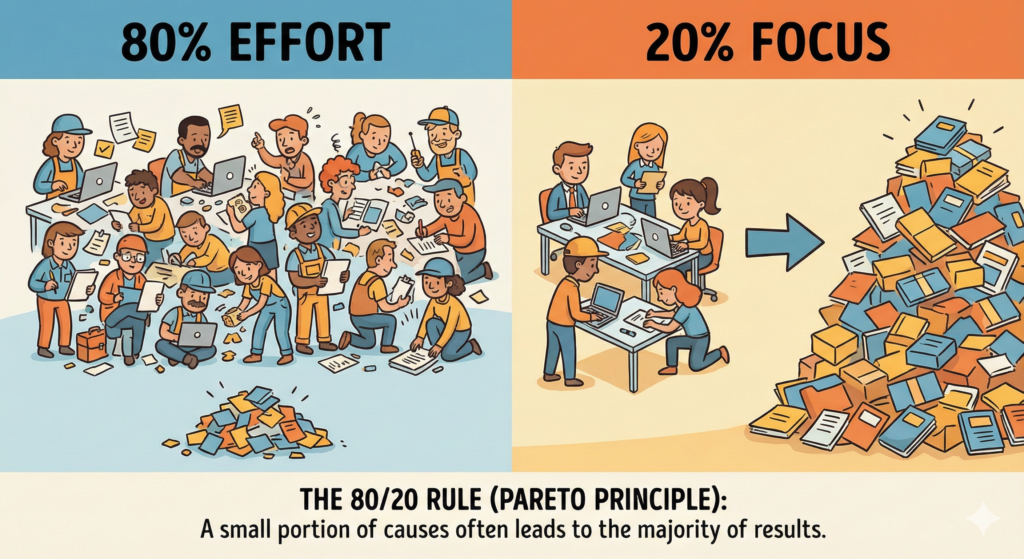
    The Pareto Principle was named after Vilfredo Pareto, an Italian economist who, in 1896, noticed a peculiar imbalance in wealth distribution: approximately 80% of the land in Italy was owned by only 20% of the population. Upon further observation, he found this ratio popped up everywhere. In his garden, 20% of the peapods produced 80% of the peas. In business, 80% of sales often come from 20% of clients. In software, 80% of errors are caused by 20% of bugs.

    The core concept is simple: inputs and outputs are rarely equal. A small minority of causes, inputs, or efforts usually lead to a majority of the results, outputs, or rewards. When we apply this to our personal lives and our lists of wishes, the implication is staggering. It suggests that of all the things you think you want, only a small fraction—the “vital few”—are actually responsible for the deep sense of satisfaction and joy you are seeking. The rest—the “trivial many”—are likely distractions, borrowed desires, or things that sound nice but won’t actually move the needle on your happiness. (For further reading, explore our guide on avoiding burnout while setting boundaries). (See also: Encyclopedia Britannica guide to the Pareto Principle).

    The Trap of the Infinite Wish List

    Why do we struggle to prioritize? Often, it is because we operate under the illusion that we have infinite time and energy. We treat our lives like a buffet where we can put everything on our plate. But life is not a buffet; it is a prix fixe menu where you have to make choices. When you load your plate with 50 different items, you end up with a mess of flavors and indigestion. You do not savor anything.

    When you have 20 “top priority” wishes, you have zero priorities. Your energy is scattered. You make an inch of progress in a dozen directions, rather than a mile of progress in the one direction that matters. This dilution of effort leads to burnout, frustration, and the sinking feeling that despite being busy, you are not actually getting anywhere. The 80/20 rule grants you permission to stop trying to be everything to everyone (including yourself) and instead double down on the things that resonate most deeply with your core self.

    Step-by-Step: Applying the 80/20 Rule to Your Wishes

    So, how do we practically apply this abstract economic theory to the emotional and personal realm of our dreams? It requires a deliberate process of auditing, scoring, and eliminating. Here is a guide to decluttering your soul’s inbox.

    1. The Grand Audit

    First, you must capture everything. Take a piece of paper or open a blank document. Write down every single wish, goal, dream, or vague desire currently occupying mental real estate. “Learn to play guitar.” “Buy a vacation home.” “Get a promotion.” “Clean the garage.” “Visit Japan.” Don’t filter yet. If it’s on your mind, it goes on the list.

    You might end up with 20, 50, or even 100 items. Seeing them all in one place can be overwhelming, but it is necessary. You cannot organize clutter until you can see the extent of it.

    2. Calculating the “Happiness ROI”

    Now, look at your list. If the Pareto Principle holds true, roughly 20% of these items will contribute to 80% of your future happiness and fulfillment. If you have 25 items on your list, that means only 5 of them really matter.

    Ask yourself for each item: If I could only achieve this one thing and nothing else on the list, how satisfied would I be with my year/life?

    You will start to notice that some wishes are “foundational.” For example, “Improving my health” might enable you to enjoy everything else. “Repairing my relationship with my sibling” might remove a massive weight from your shoulders, changing your daily mood. In contrast, “Buying a new 4K TV” might provide a spike of dopamine, but its long-term contribution to your fulfillment is negligible.

    3. Identify the “Domino Wishes”

    Tim Ferriss often talks about “domino” actions—things that, if done, make everything else easier or unnecessary. Look for wishes that have a domino effect. Perhaps “Starting a side business” (Wish A) provides the extra income to “Travel more” (Wish B) and “Pay off debt” (Wish C). In this case, focusing on Wish A addresses the others indirectly. The 20% often consists of these high-leverage wishes.

    4. The Pain of Elimination

    Here is the hard part. Once you have identified your top 20%, you must look at the bottom 80%. These are not necessarily “bad” wishes. They are often “good” wishes. They are things you genuinely like. But they are the enemy of the “great.”

    Warren Buffett famously advised his pilot to list his top 25 goals, circle the top 5, and then put the other 20 on an “Avoid At All Costs” list. You don’t just put them on the back burner; you actively avoid them because they are the seductive distractions that will eat up the time you need for your top 5. You have to be willing to mourn the loss of those alternative futures to fully inhabit the one you are choosing.

    Living in the 20% Zone

    When you focus your resources—time, money, emotional bandwidth—on just your top wishes, magic happens. You move faster. You achieve a state of “flow” more easily because you aren’t constantly context-switching between disparate goals. If your top wish is to write a novel, and you cut out the hours spent researching pottery classes (a bottom 80% wish) or browsing real estate (another bottom 80% wish), you suddenly find you have the time to actually write.

    Furthermore, the 20% are usually the wishes that align most closely with your values. The other 80% are often influenced by society, advertising, or peer pressure. By stripping those away, you aren’t just becoming more productive; you are becoming more authentic.

    Overcoming the Fear of Missing Out (FOMO)

    The biggest psychological barrier to the 80/20 rule is FOMO. “But what if I really discover I love pottery?” “What if I regret not learning Italian?”

    The antidote to FOMO is JOMO: the Joy of Missing Out. There is a deep, resonant joy in commitment. When you commit to your top wishes, you go deep rather than wide. The satisfaction of mastery and completion outweighs the shallow thrill of novelty. Remember, prioritizing the 20% doesn’t mean you can never do the other things. It just means you aren’t doing them now. You are sequencing your life instead of trying to run everything in parallel.

    the 80/20 principle at work

    Frequently Asked Questions (FAQ)

    1. Can I have different 80/20 lists for different areas of life?

    Yes. You can apply this rule separately to your career, your relationships, and your hobbies. However, be careful not to create so many sub-categories that you end up with a crowded plate again. Ideally, you should have one master list for your overall time allocation.

    2. What if my top 20% wishes keep changing?

    It is normal for desires to evolve, but if they change weekly, you might be stuck in the dreaming phase rather than the doing phase. Try to stick with your top selection for at least 3 to 6 months to give yourself a chance to see results before re-evaluating.

    3. Is the ratio always exactly 80/20?

    No, it is a heuristic, not a law of physics. It could be 90/10 or 70/30. The point is the inequality: a small number of inputs creates the majority of value. Don’t get hung up on the math; focus on the concept of leverage.

    4. Isn’t this approach selfish?

    Prioritizing your wishes doesn’t mean ignoring your responsibilities to others. In fact, many people find that “Being a better parent” or “Contributing to my community” lands squarely in their top 20%. By clearing out the trivial clutter, you often have more energy to be present for the people who matter most.

    The Courage to Choose

    Using the 80/20 rule to prioritize your wishes is ultimately an act of courage. It requires the bravery to say “no” to good things so that you can say “yes” to the best things. It forces you to confront the finitude of your time and make peace with it.

    Take a look at your list today. Find those golden few, the wishes that make your heart race, the ones that align with your deepest purpose, the ones that, if fulfilled, would make you feel that your life has been well-spent. Circle them. Cherish them. And then, gently but firmly, let the rest go. Your future self, unburdened and fulfilled, will thank you for it.

  • Vision Board Alternatives: Best Digital Tools to Manifest Goals

    Vision Board Alternatives: Best Digital Tools to Manifest Goals

    Vision Board Alternatives: The Digital Way to Visualize Your Wishes

    For decades, the “Vision Board” has been a staple in the world of personal development. The ritual is almost sacred: gather a stack of glossy magazines, a pair of scissors, a glue stick, and a large piece of poster board. Spend a Sunday afternoon cutting out photos of tropical beaches, luxury cars, toned bodies, and inspirational quotes, then paste them into a collage that hangs on your wall.

    While this tactile process has its charm, it also has significant limitations. It’s messy. It’s static. It’s hard to update. And purely from a practical standpoint, finding the exact image of your dream life in a random stack of National Geographic or Vogue is a game of chance. Welcome to the digital age, where visualizing your wishes is faster, cleaner, more private, and infinitely more customizable. In this guide, we will explore the best digital alternatives to the traditional vision board and how they can supercharge your manifestation process.

    Why Go Digital? The Case Against Glue Sticks

    Before we dive into the tools, let’s understand why a digital shift might be the upgrade your goals need.

    1. Accessibility and Portability

    A physical board usually lives in one place—your bedroom or home office. But where do you spend most of your time? Likely looking at a screen (phone or laptop). A digital vision board travels with you. Whether you are commuting, standing in line for coffee, or taking a break at work, your goals are just a click away.

    2. Privacy

    Not everyone wants their deepest desires on display for every guest who walks into their home. “I want to earn 100k” or “I want to find a partner” can be deeply personal. Digital boards are for your eyes only, unless you choose to share them.

    3. Dynamic and Editable

    Life changes fast. Maybe in January, you wanted a sports car, but by June, you want a reliable SUV for a family road trip. On a physical board, ripping off the old picture ruins the aesthetic. Digitally, it’s a simple delete and replace. Your vision grows as you grow.

    Top Digital Alternatives to the Classic Vision Board

    Tool / Platform Best For Portability Action-Orientation
    Physical Poster Board Tactile, bedroom wall focus Low Static / Visual
    Pinterest Boards Infinite imagery & aesthetic inspiration High (Mobile/Desktop) Inspirational
    Canva Wallpaper Custom lock screens & collage collages Very High (Daily exposure) Subconscious priming
    Notion Dashboard Linking vision to daily tasks & habits High Execution-focused

    You don’t need expensive software to create a stunning visualization of your future. Here are the best tools, ranging from free to premium.

    1. Pinterest: The Infinite Catalog

    Pinterest is arguably the original digital vision board. It is a search engine for images, meaning you aren’t limited to what’s in a magazine. You can find the specific model of that watch, the exact interior design style for your living room, or the precise quote that motivates you.

    Pro Tip: Don’t just make one giant board called “Life.” Create specific sections: “2025 Travel,” “Dream Home,” “Career Style.” Use the “Secret Board” feature if you want to keep your dreams private.

    2. Canva: The Design Powerhouse

    If you miss the collage aspect of traditional boards, Canva is your best friend. They offer hundreds of “Vision Board” templates (Search: “Desktop Wallpaper Vision Board” or “Phone Wallpaper Collage”).

    The Strategy: Create a design that fits your laptop screen resolution. Import photos that evoke strong emotions. Add text overlays with your S.M.A.R.T. goals. Save it as your desktop background. Now, every time you minimize a window, you are subconsciously reminded of where you are heading.

    3. Trello or Notion: The Action-Oriented Vision

    For the analytical minds who love logic, Trello and Notion are game-changers. These aren’t just for images; they are for planning.

    • Trello: Create a board where each list is a category (Health, Wealth, Love). The “cards” in the lists are your goals. The cover image of the card is your vision photo. When you open the card, you can add checklists, deadlines, and links.
    • Notion: Build a “Life Dashboard.” Embed a gallery view database where you can see your goals. The beauty of Notion is you can link a vision image directly to your habit tracker, bridging the gap between wishing and doing.

    4. Dedicated Vision Board Apps

    There are apps designed specifically for this purpose. Visuapp and Hay House Vision Board allow you to upload photos, add music, and create a slideshow. The “slideshow” feature is powerful—you can set a timer to watch your life goals flash before your eyes for 5 minutes every morning, priming your brain for the day.

    How to Create a Digital Vision Board That Actually Works

    Dragging and dropping images is easy. Creating a tool that shifts your psychology requires intention. Here is a step-by-step process.

    Step 1: Curate High-Vibration Images

    Don’t just pick the first image you see on Google Images. Use high-quality stock photo sites like Unsplash, Pexels, or Pixabay. The image needs to spark a visceral emotional reaction. If you want a vacation, don’t just use a generic picture of a plane. Find a POV (Point of View) shot of someone holding a cocktail on the specific beach in Maui you want to visit. POV shots help your brain visualize you in the scene, not just you looking at the scene.

    Step 2: The Power of Affirmations

    Images are powerful, but words provide direction. Overlay text on your digital board. Use present tense.

    • Instead of “I want a new job,” write: “I am thriving in my creative leadership role.”
    • Instead of “Healthy body,” write: “I feel energetic and strong in my skin.”

    Step 3: Strategic Placement

    A digital file sitting in a folder named “Downloads” does nothing. You must force exposure.

    • Phone Lock Screen: You look at your phone roughly 80 times a day. That is 80 subconscious reminders of your goal.
    • Browser Start Page: Use extensions like “Momentum” or customize Chrome to show your vision board when you open a new tab.
    • Digital Photo Frame: Invest in a digital frame for your desk that cycles through your vision images. It acts as a passive reinforcement loop while you work.

    The Hybrid Approach: Best of Both Worlds

    You don’t have to choose one camp. The “Hybrid Method” involves designing your board digitally (using Canva or Photoshop) to get the perfect layout and aesthetic, and then having it professionally printed.

    Print it on high-quality photo paper, canvas, or even metal. This gives you the clean, curated look of a digital design with the tangible presence of a physical object. It’s perfect for the “centerpiece” vision board in your home office.

    Frequently Asked Questions (FAQ)

    Q: Is a digital vision board as effective as a physical one?
    A: Effectiveness depends on engagement. If you look at your phone wallpaper 50 times a day, a digital board is more effective than a physical one you walk past once. The medium matters less than the frequency of exposure.

    Q: How many images should I have?
    A: Avoid clutter. If you have 50 tiny images on a phone screen, your brain registers it as noise. Focus on 5-7 core images that represent your major pillars for the year (Health, Career, Relationship, Self). “Less is more” applies here.

    Q: How often should I update my digital vision board?
    A: As often as your desires change. A good rule of thumb is a quarterly review. Check in: “Does this image still make me excited?” If not, swap it out. This keeps the dopamine response fresh.

    Q: Can I use video?
    A: Yes! This is the unique advantage of digital. “Mind Movies” are short video montages of your goals set to inspiring music. You can make these on TikTok or Instagram Reels having a private account, and watch them every morning.

    Conclusion

    The essence of a vision board is not the paper or the pixels—it is the clarity. It is the act of claiming what you want from the universe and keeping that desire at the forefront of your mind. Digital alternatives offer a modern, flexible, and highly effective way to do just that.

    Whether you choose a carefully curated Pinterest board, a sleek Canva desktop wallpaper, or a Notion dashboard, the goal remains the same: to align your subconscious mind with your conscious desires. So, put down the scissors, open your laptop, and start designing your future today. The only limit is your imagination (and maybe your screen resolution).

  • The Power of Writing Down Your Goals: Science & Strategy

    The Power of Writing Down Your Goals: Science & Strategy

    The Power of Writing Down Your Goals (And Why You Should Share Them)

    You have a goal. Maybe it’s a whisper in the back of your mind, a fleeting thought while you are driving, or a daydream that hits you during a boring meeting. “I want to start a podcast.” “I want to run a marathon.” “I want to buy a house.” These thoughts are potent seeds, but as long as they remain in your head, they are just that—seeds floating in the wind, unlikely to take root. (For further reading, explore our guide on turning your wishes into concrete goals).

    The act of taking a pen to paper (or fingers to keyboard) and externalizing that thought is the first step in the alchemy of success. It transforms the intangible into the tangible. But why does this simple act hold such power? And once written, should you keep it a secret or shout it from the rooftops? In this deep dive, we explore the neuroscience behind writing down your goals and the social psychology of sharing them.

    The Neuroscience of Writing It Down

    Writing is not just a record-keeping activity; it is a cognitive process. When you write down a goal, you are engaging in what neuroscientists call “encoding.” (For further reading, explore our guide on daily habits of successful achievers). (See also: Dr. Gail Matthews’ study on goal achievement).

    The Generation Effect

    Psychological research demonstrates the “Generation Effect,” which states that information you generate yourself (like writing a goal) is better remembered than information you simply read or think about. By writing it, you are stamping the goal into your hippocampus, the brain’s memory center.

    Hemispheric Synchronization

    The act of writing engages the left hemisphere of the brain (logic, language) while the visualization of the goal engages the right hemisphere (imagination, creativity). This synchronization signals to your brain that this is not just a passing fancy, but a priority information packet. It activates the Reticular Activating System (RAS), which then filters your reality to show you opportunities that align with your written goal.

    The Statistics: Why The Pen is Mightier

    Method / Habit Success Rate (%) Psychological Mechanism
    Keeping Goals in Mind Only ~43% Passive intent, high cognitive decay
    Writing Goals Down (Handwritten) ~61% Generation effect & motor cortex encoding
    Writing + Progress Reports to Partner ~76% Social accountability & neuro-feedback loop

    A famous study by Dr. Gail Matthews at Dominican University provided empirical evidence for this phenomenon. She found that people who wrote down their goals were 42% more likely to achieve them than those who didn’t. That is a massive statistical edge for something that takes five minutes and costs nothing.

    The study went further. The group that achieved the most didn’t just write goals; they also formulated action commitments and sent weekly progress reports to a friend. This brings us to the second half of the equation: Sharing.

    To Share or Not to Share?

    There is a debate in the self-help world. Some, like Derek Sivers in his viral TED Talk, argue that sharing goals gives you a “premature sense of completion.” Your brain gets the dopamine hit of the praise (“Wow, you’re writing a book? That’s amazing!”) without doing the work, which can actually decrease motivation.

    However, the nuance lies in who you share with and how.

    The Accountability Partner vs. The Audience

    Posting “I’m going to be a millionaire!” on Facebook might trigger the Sivers effect. It’s vanity validation. But sharing “I commit to making 50 sales calls this week” with a mentor or a mastermind group creates social pressure.

    We are social animals. We care deeply about our reputation. If we tell someone we respect that we will do something, the fear of letting them down (and losing status) becomes a powerful motivator that overrides laziness. This is positive accountability.

    A 4-Step Framework for Success

    Combine the power of writing and sharing with this protocol:

    1. Write it Specific: Don’t write “get healthy.” Write “Run 3x a week for 30 minutes.”
    2. Write it Daily: Re-writing your goals every morning keeps the RAS primed. It reminds you why you are waking up.
    3. Share the Process, Not Just the Outcome: Tell your accountability partner what you will do (the inputs), not just what you want to have (the outputs).
    4. Review and Reflect: A written goal is a living document. Review it weekly. Did you hit the mark? If not, why?

    Frequently Asked Questions (FAQ)

    Q: Does typing count, or must it be handwritten?
    A: Handwriting is slightly better for memory retention due to the complex motor skills involved, but typing is 90% of the way there. The best method is the one you will actually do consistently.

    Q: Who should I share my goals with?
    A: Share with “Supportive Critics.” People who want you to win but aren’t afraid to call you out if you slack off. Avoid “Yes Men” and avoid “Dream Killers” (pessimists).

    Q: What if I write it down and don’t achieve it?
    A: Then you have data. A goal in your head that fails disappears into the ether. A written goal that fails leaves a trail. You can analyze it. Was the timeline unrealistic? Did you lack resources? Failure on paper is a lesson; failure in the mind is a regret.

    Conclusion

    Your life is a story. If you don’t write the script, someone else will. By writing down your goals, you take the pen back. You declare to yourself and the world that you are the author of your destiny. And by sharing those goals with the right people, you ensure you have a cast of supporting characters to help you reach the climax.

    Don’t let your dreams dissolve in the morning mist. Capture them. Ink them. Share them. And then, work for them.


  • Wish List vs. To-Do List: Understanding the Difference for Success

    Wish List vs. To-Do List: Understanding the Difference for Success

    Wish List vs. To-Do List: Understanding the Difference for Success

    We have all been there. You buy a crisp new planner, grab a smooth-writing pen, and sit down to “get organized.” You write down everything you want to accomplish: “Learn Italian,” “Buy milk,” “Visit Japan,” “Call mom,” “Start a business.” You feel a surge of productivity. But a week later, the milk is bought and mom has been called, yet “Start a business” keeps getting copied over to the next day, and the next, and the next.

    Eventually, it becomes background noise. A symbol of failure. Why? Because you committed a cardinal sin of productivity: you mixed your Wish List with your To-Do List.

    Understanding the distinction between these two powerful tools is often the missing link between people who dream and people who achieve. In this comprehensive guide, we will dissect the anatomy of wishes and tasks, explore why mixing them is a recipe for stagnation, and provide a clear framework for bridging the gap between what you want and what you do.

    The Anatomy of a Wish List

    A Wish List (often called a bucket list, dream board, or “someday/maybe” list) is a repository for your desires. It is a place of infinite possibility and zero immediate obligation.

    Characteristics of a Wish List


    • Vague High-Level Concepts: Entries often look like “Get fit” or “Write a novel.”
    • No Specific Deadline: They exist in the realm of “someday.”
    • Emotional Resonance: They are driven by “I want” or “I hope.”
    • Zero Immediate Accountability: There is no consequence for not doing it today.

    The purpose of a wish list is inspiration. It allows your brain to explore potential futures without the pressure of execution. It is vital for maintaining long-term vision and ensuring that your daily grind is actually moving you toward a life you want to live. However, a wish list is not un-actionable; it is simply pre-actionable.

    The Anatomy of a To-Do List

    A To-Do List is a tactical battle plan. It is a set of instructions you give to your future self. If a Wish List is a map of the world, a To-Do List is the turn-by-turn navigation for the next mile.

    Characteristics of a To-Do List


    • Action-Oriented Verbs: Entries start with verbs like “Email,” “Draft,” “Buy,” or “Schedule.”
    • Binary Completion: A task is either done or not done. There is no gray area.
    • Time-Bound: Tasks have a specific context or deadline (e.g., “Today,” “Friday at 2 PM”).
    • Resource-Aware: You know exactly what tools or information you need to complete it.

    The purpose of a To-Do list is execution. It removes the need for thinking so you can focus on doing.

    The Danger of The Hybrid List

    The problem arises when we treat wishes as tasks. When you write “Learn Italian” on your Tuesday to-do list, you are setting yourself up for failure. “Learn Italian” is not a task; it is a project, a lifestyle change, or a wish.

    When your brain scans your list and sees “Buy milk” (easy, quick) next to “Write book” (huge, undefined, scary), it will naturally gravitate toward the milk. This is known as the principle of least resistance. The “Write book” item remains unchecked day after day, slowly transforming from a source of inspiration into a source of guilt.

    This hybrid list creates a false sense of failure. You aren’t lazy; you just have a categorization error.

    Bridge the Gap: From Wish to To-Do

    Success requires a bridge. You cannot jump directly from “I wish” to “I did.” You need a translation layer, often called Project Management or Goal Setting.

    Step 1: The Capture (The Wish List)

    Keep a dedicated place for wishes. This could be a Pinterest board, a “Someday/Maybe” folder in your notes app, or the back of your journal. Let your imagination run wild here.

    Step 2: The Selection (The Goal)

    Periodically (quarterly or monthly), review your wish list. Pick one or two items to promote to active status. Turn the wish into a S.M.A.R.T. goal (as discussed in our previous article). “Learn Italian” becomes “Complete the immense beginner Italian course by June.”

    Step 3: The Breakdown (The Project Plan)

    Break that goal into milestones and chunks. This is still not your to-do list. This is your project plan.

    Step 4: The Next Action (The To-Do List)

    Extract the very next physical action required to move the project forward. Put that on your daily to-do list.
    Wish: Learn Italian.
    Goal: Complete Level 1 by June.
    To-Do: “Download Duolingo app” or “Research local tutors for 15 minutes.”

    Tools for Management

    Separating these lists often requires separate containers (physical or digital) to keep your mental state clear.

    For Wish Lists:


    • Physical: A dedicated “Dream Journal.”
    • Digital: Pinterest, Evernote “Someday” notebook, Apple Notes.

    For To-Do Lists:


    • Physical: Daily planner, sticky notes, Bullet Journal (Daily Log).
    • Digital: Todoist, Things 3, Microsoft To Do, Google Tasks.

    Frequently Asked Questions (FAQ)

    Q: Is it okay to put big things on a to-do list for visibility?
    A: It generally backfires. If you want visibility for a big goal, write it at the top of the page as a “Focus” or “Mantra,” but do not put a checkbox next to it. Checkboxes are for completed actions, not ongoing states.

    Q: How often should I look at my wish list?
    A: Weekly or Monthly. David Allen, author of Getting Things Done, recommends a Weekly Review. This ensures your wishes don’t die of neglect and that your daily to-do list remains aligned with your long-term desires.

    Q: What if a task on my to-do list stays there for two weeks?
    A: That is a red flag. It usually means one of three things: 1) It’s actually a wish/project disguised as a task (break it down). 2) You don’t actually want to do it (delete it). 3) You are missing a resource/input to do it (add a task to get the resource).

    Q: Can I have multiple to-do lists?
    A: Yes, context lists are helpful. You might have a “Work” list, a “Home” list, and an “Errands” list. However, try to work from a single “Today” view so you don’t overestimate your capacity.

    Conclusion

    The journey from “I wish” to “I did” is paved with specific actions. By respecting the difference between your Wish List and your To-Do List, you honor both your dreams and your reality. Your Wish List protects your vision, while your To-Do List protects your time. When you stop confusing the two, you stop feeling overwhelmed by your dreams and start building them, one checked box at a time.

    Start today. Look at your current to-do list. Identify the “wishes” hiding there, move them to a safe place, and replace them with a single, small, actionable step. That is how success happens.

  • SMART Goals for 2025: Why Specificity is Your Superpower

    SMART Goals for 2025: Why Specificity is Your Superpower

    SMART Goals for 2025: Why Specificity is Your Superpower

    As the calendar turns to 2025, the air is thick with the promise of new beginnings. We all feel it—that surge of motivation to shed old habits and embrace a better version of ourselves. Yet, if history tells us anything, it’s that by mid-February, nearly 80% of New Year’s resolutions will have been abandoned. Why do so many well-intentioned plans crumble? The answer often lies not in a lack of willpower, but in a lack of clarity.

    Enter SMART goals. While you’ve likely heard the acronym, mostly in corporate boardrooms or management seminars, its application to personal growth is profound. In 2025, the difference between dreaming and achieving will be defined by one crucial element: Specificity. This guide will not only break down the S.M.A.R.T. framework but will dive deep into why narrowing your focus is actually the most expansive thing you can do for your future.

    Decoding the S.M.A.R.T. Framework

    Before we crown specificity as the king of goal-setting, let’s revisit the foundational framework that has stood the test of time since George T. Doran introduced it in 1981.

    S – Specific

    A goal must be clear and unambiguous. Vague aspirations like "I want to be rich" or "I want to lose weight" are destined to fail because they don't provide a roadmap. Specificity answers the five "W" questions: What do I want to accomplish? Why is this goal important? Who is involved? Where is it located? Which resources or limits are involved?

    M – Measurable

    If you can’t measure it, you can’t manage it. A measurable goal allows you to track your progress and stay motivated. Assessing progress helps you to stay focused, meet your deadlines, and feel the excitement of getting closer to achieving your goal. It answers questions like: "How much?", "How many?", and "How will I know when it is accomplished?"

    A – Achievable

    Your goal also needs to be realistic and attainable to be successful. In other words, it should stretch your abilities but still remain possible. When you set an achievable goal, you may be able to identify previously overlooked opportunities or resources that can bring you closer to it. An achievable goal will usually answer the question: How can I accomplish this goal?

    R – Relevant

    This step ensures that your goal matters to you, and that it also aligns with other relevant goals. We all need support and assistance in achieving our goals, but it is important to retain control over them. A relevant goal can answer "yes" to these questions: Does this seem worthwhile? Is this the right time? Does this match our other efforts/needs?

    T – Time-bound

    Every goal needs a target date, so that you have a deadline to focus on and something to work toward. This part of the SMART goal criteria helps to prevent everyday tasks from taking priority over your longer-term goals. A time-bound goal will usually answer these questions: When? What can I do six months from now? What can I do today?

    Why Specificity is Your Superpower in 2025

    Among the five pillars of SMART goals, Specificity is often the most undervalued. We tend to keep our goals vague to protect ourselves from the pain of failure. If you say, “I want to get fit,” you can’t technically fail because the finish line is never drawn. But you also can’t technically succeed.

    Specificity acts as a superpower for your brain. It leverages the Reticular Activating System (RAS), a bundle of nerves at our brainstem that filters out unnecessary information so the important stuff gets through. When you set a specific goal, like "I will drive a red Tesla Model 3," you suddenly start seeing red Teslas everywhere. Your brain is priming you to notice opportunities relevant to your specific target.

    In 2025, the world will likely be even more distracted and noisy. Specificity cuts through the noise. It transforms a wish (“I want to write a book”) into a directive (“I will write 500 words every morning at 6 AM to complete a 50,000-word manuscript by June 1st”). This level of detail removes decision fatigue. You don't wake up wondering *if* you should write or *what* you should write; the specific plan dictates the action.

    Applying Specificity: Variable vs. SMART

    Let’s look at how to transform common 2025 resolutions into specific, superpower-charged missions.

    Career Growth

    • Vague: "I want to get a promotion."
    • Specific & SMART: "I will obtain the Senior Project Manager certification by completing the online course by March 31st and leading two cross-departmental initiatives in Q2 to demonstrate leadership readiness for the upcoming review cycle."

    Financial Health

    • Vague: "I want to save more money."
    • Specific & SMART: "I will save $10,000 for a down payment on a house by December 31st, 2025, by automatically transferring $833 from my paycheck to a high-yield savings account on the 1st of every month."

    Physical Wellness

    • Vague: "I want to loose weight."
    • Specific & SMART: "I will lose 15 pounds by May 1st by attending spin classes three times a week (Mon, Wed, Fri) and adhering to a Mediterranean diet with a daily caloric limit of 1,800."

    Implementation Strategy: The 2025 Roadmap

    To truly harness this power, you need more than just a statement. You need a system. Here is a step-by-step strategy to implementing your specific goals this year.

    1. Audit Your Desires: Write down everything you think you want. Then, ruthlessly cut the list down to the top 3 priorities. Specificity requires focus; you cannot be specific about 20 different things simultaneously.
    2. The "So That" Test: For every specific goal, add the phrase "so that." For example, "I will run a 5k in under 25 minutes so that I have the cardiovascular endurance to hike the Inca Trail in September." This connects specificity to motivation.
    3. Visualize the Micro-Steps: Break the specific goal down. If the goal is to save $10,000, the micro-step is setting up the auto-transfer. If the goal is writing a book, the micro-step is opening the laptop.
    4. Review and Refine: A specific goal in January might need adjustment in July. That’s okay. The point of specificity is not rigidity, but clarity of direction.

    Frequently Asked Questions (FAQ)

    Q: Can a goal be too specific?
    A: Yes, if it becomes restrictive to the point of anxiety. "I want to lose 10 pounds" is good. "I must lose exactly 10 pounds by 9:00 AM on February 12th" might set you up for unnecessary stress. Balance specificity with sanity.

    Q: What if I miss my specific target?
    A: This is the beauty of measurable goals—feedback. Missing a global works as data, not a judgment of character. If you aimed to save $10,000 and saved $8,000, you are still $8,000 richer than you were. Analyze why you missed the specific target and adjust.

    Q: How many SMART goals should I set for 2025?
    A: Less is more. Try setting one major specific goal for each key area of life: Health, Wealth, and Relationships. Overtaxing your willpower with 10 different specific targets often leads to burnout.

    Q: Is it better to share my specific goals or keep them private?
    A: Research is mixed, but sharing specific goals with a mentor or accountability partner usually increases success rates. However, announcing them to the world on social media can sometimes give you a premature dopamine hit, making you feel like you've already achieved them.

    Conclusion

    As we embark on the journey that is 2025, resist the urge to make sweeping, cinematic declarations about changing your entire life. Instead, embrace the quiet, boring, and tremendously effective power of specificity. By defining exactly what you want, how you will get it, and when you will arrive, you are not just setting a goal; you are engineering your future.

    Specificity is your superpower because it turns the invisible into the visible. It turns the impossible into the actionable. So, grab a pen, sit down, and get specific. Your 2025 self is waiting for the details.

  • How to Combat Procrastination

    How to Combat Procrastination

    How to Combat Procrastination When Chasing a Big Dream: The Ultimate Guide

    We all have that one Big Dream.

    Maybe it is writing a novel that defines a generation. Maybe it is launching a tech startup that disrupts an industry. Maybe it is achieving total financial freedom or mastering a new language. The dream is vibrant, exciting, and full of potential. It keeps you up at night with possibilities.

    But when the morning comes and it is time to work on that dream, something strange happens. You freeze.

    You reorganize your desk. You scroll through social media “looking for inspiration.” You answer unimportant emails. You convince yourself that you need to read just one more book on the subject before you start.

    This is the Paralysis of Magnitude.

    When a dream is big, it is also heavy. It carries the weight of expectation, the fear of failure, and the intimidation of a thousand unknown steps. Paradoxically, the more you want something, the harder it can be to start working on it.

    If you are currently stuck in this loop, you are not lazy, and you are not broken. You are dealing with a complex psychological response to high stakes. In this guide, we are going to deconstruct why we stall on our biggest ambitions and provide you with a battle-tested roadmap on how to combat procrastination and turn that massive dream into manageable reality.

    The Psychology: Why We Stifle Our Own Dreams

    To defeat the enemy, you must understand the enemy. Procrastination is often mislabeled as a time management issue. If you just bought a better planner or downloaded a new app, you’d be fine, right?

    Wrong. Procrastination is an emotional regulation problem, not a time management problem.

    When you look at your Big Dream, your brain’s limbic system (the ancient, emotional part) detects a threat.

    • The Threat of Failure: “What if I try and I’m not good enough?”
    • The Threat of Discomfort: “This is going to be hard and boring.”
    • The Threat of Identity Loss: “If I write this book and people hate it, who am I?”

    Your brain wants to protect you from these negative feelings. So, it urges you to do something that provides immediate dopamine and safety like watching Netflix or cleaning the kitchen. Procrastination is your brain’s misguided way of keeping you safe from the emotional pain of your own ambition.

    Understanding this is the first step to freedom. You aren’t fighting a lack of discipline; you are soothing a frightened brain.

    Strategy 1: The “Salami Slice” Method (Micro-Stepping)

    The sheer size of a Big Dream is what triggers the fear response. If your to-do list says “Build a Profitable Business,” your brain will shut down. It is too vague and too massive.

    You need to slice the task so thin that it becomes impossible to say no to it. This is often called the “Salami Slice” method.

    How to Apply It

    Don’t focus on the outcome; focus on the stupidly small entry point.

    • Instead of: “Write Chapter 1.”
    • Try: “Open the document and write three sentences.”
    • Instead of: “Create a marketing strategy.”
    • Try: “List 5 potential competitors.”
    • Instead of: “Go to the gym for an hour.”
    • Try: “Put on my running shoes.”

    When you lower the barrier to entry, you bypass the limbic system’s “fight or flight” response. Once you start, the physics of productivity takes over: an object in motion stays in motion. The hardest part is always the first two minutes.

    Action Item: Take your biggest, scariest task for today. Break it down into a step so small that it feels ridiculous. Do that step immediately after reading this section.

    Strategy 2: Forgive Your Past Self

    This might sound like advice for a therapy session, but it is scientifically proven productivity advice.

    A study conducted at Carleton University found that students who forgave themselves for procrastinating on studying for the first exam ended up procrastinating less for the second exam. Those who beat themselves up (“I’m so lazy,” “I always do this”) continued to procrastinate.

    The Guilt-Procrastination Loop

    1. You procrastinate.
    2. You feel guilty and ashamed.
    3. These negative emotions make the task feel even more painful and associated with negativity.
    4. You avoid the task again to avoid the negative feelings.

    To combat procrastination, you must break the loop. Acknowledge that you slipped up, accept that it is a human response to stress, and reset. Shame is a heavy backpack; you cannot run a marathon wearing it. Put it down.

    Action Item: Say this out loud: “I procrastinated yesterday. That is okay. Today is a fresh start, and my past actions do not dictate my future performance.”

    Strategy 3: Design Your Environment for Flow

    Willpower is a finite resource. If you have to use willpower to ignore your phone, ignore the TV, and ignore the clutter on your desk, you will have zero energy left for your Big Dream.

    You need to design an environment where doing the work is the path of least resistance.

    The Concept of Friction

    • Increase Friction for bad habits: Put your phone in another room. Unplug the TV. Log out of social media accounts.
    • Decrease Friction for your dream: Have your notebook open on your desk. Have your gym clothes laid out the night before. Have your research tabs open.

    If you want to write, your writing space should be a sanctuary. If you want to trade stocks or manage finances, your workspace should be clean and optimized for data analysis.

    Digital Minimalism

    For big dreams that require deep focus (Deep Work), digital distractions are the enemy.

    • Use tools like Freedom or Cold Turkey to block distracting websites during work hours.
    • Turn off all non-human notifications (news apps, game alerts).

    Action Item: Look at your workspace right now. Identify three things that are competing for your attention and remove them.

    Strategy 4: Utilize “Temptation Bundling”

    Katy Milkman, a behavioral economist at UPenn, coined the term “Temptation Bundling.” It involves coupling something you want to do with something you need to do.

    This is a powerful way to combat procrastination because it rewires the reward system. You stop dreading the task and start looking forward to the “bundle.”

    Examples of Bundling

    • The Podcast Bundle: You can only listen to your favorite true crime podcast while you are organizing your business receipts or cleaning the house.
    • The Coffee Shop Bundle: You can only drink that expensive $7 latte while you are sitting down to work on your coding project.
    • The Music Bundle: You have a specific playlist of your favorite high-energy songs that you only listen to when you are tackling your most difficult task.

    By linking a treat to the action, you bridge the gap between present pain and future gain.

    Action Item: Identify one “guilty pleasure” you enjoy (music, podcasts, specific snacks, a location) and create a rule that you can only access it when you are working on your Big Dream.

    Strategy 5: The “Fear Setting” Exercise

    We often procrastinate because we have a vague, undefined fear of what happens if things go wrong. Seneca, the Stoic philosopher, said, “We suffer more often in imagination than in reality.”

    Tim Ferriss popularized an exercise called Fear Setting. Instead of defining your goals, define your fears.

    The 3 Page Exercise

    1. Define: What is the absolute worst thing that could happen if you take action on this dream? Be specific. (e.g., “I lose $500,” “Someone laughs at my article”).
    2. Prevent: What could you do to prevent this from happening? (e.g., “Set a stop loss limit,” “Ask a friend to edit before publishing”).
    3. Repair: If the worst happened, how would you fix it? (e.g., “Pick up an extra freelance shift to make back the money”).

    Usually, when you write these down, you realize that the “worst-case scenario” is not fatal. It is uncomfortable, sure, but it is survivable. Once the monster in the closet is revealed to be just a pile of clothes, you can get back to work.

    Strategy 6: Embrace “B-Minus Work”

    Perfectionism is procrastination in a tuxedo. It looks fancy, but it stops you from moving.

    When chasing a Big Dream, we often feel that every step must be perfect. We think, “I can’t launch the website until the logo is award winning” or “I can’t invest until I know everything about the market.”

    This is a trap. Quantity leads to quality. The potter who throws 100 messy pots learns more than the potter who spends a month trying to make one perfect pot.

    Give yourself permission to do “B-Minus Work.”

    • Write a terrible first draft.
    • Launch a buggy beta version.
    • Record a podcast with mediocre audio.

    You can fix a bad page. You cannot fix a blank page.

    Action Item: Adopt the mantra “Done is better than perfect.” Set a timer for 20 minutes and produce something anything regardless of quality.

    Strategy 7: The Seinfeld Strategy (Don’t Break the Chain)

    Jerry Seinfeld was once asked by a young comic how to get better. His advice was simple: Write a joke every day.

    He suggested getting a big wall calendar and a red marker. Every day that you do the task (work on your dream), put a big red X over that day. After a few days, you’ll have a chain. Just keep at it and the chain will grow longer every day.

    “You’ll like seeing that chain, especially when you get a few weeks under your belt. Your only job next is to not break the chain.”

    Why It Works

    This visualizes your consistency. When you procrastinate, you aren’t just delaying work; you are breaking a streak that you have invested in. It gamifies the process.

    Action Item: Buy a physical calendar or use a habit-tracking app. Start your chain today.

    The Pain of Regret weighs Tons

    There are two types of pain in life: the pain of discipline and the pain of regret.

    The pain of discipline weighs ounces. It is the slight discomfort of turning off the TV, the brief anxiety of opening a blank document, or the fatigue of waking up an hour early.

    The pain of regret weighs tons. It is the heavy, crushing realization ten years from now that you had the potential, you had the time, and you had the dream, but you didn’t have the courage to start.

    Combating procrastination is not about becoming a robot. It is about respecting your own potential. It is about understanding that your Big Dream is worth the discomfort of the work.

    You have the strategies. You know about micro steps, environment design, and fear setting. The only thing missing is the action.

    Do not wait for motivation to strike. Motivation is a flaky friend who only shows up when the party is already started. Discipline is the loyal friend who helps you build the venue.

    Start today. Start small. But for the love of your future self, start.

    FAQ: Frequently Asked Questions

    1. Is procrastination a sign that I don’t really want my dream? Not necessarily. In fact, it’s often the opposite. We tend to procrastinate more on things that are important to us because the stakes feel higher. If you didn’t care, you wouldn’t feel the anxiety that causes procrastination. It is a sign of how much this matters to you.

    2. How do I distinguish between procrastination and burnout? Procrastination is avoiding a task despite having the energy to do other things (like play video games or clean). Burnout is a state of total emotional, physical, and mental exhaustion where you cannot bring yourself to do anything. If you are burned out, the solution is rest, not “productivity hacks.”

    3. What if my dream feels too big and I don’t know where to start? This is the “fog of war.” You don’t need to see the whole staircase to take the first step. Pick the one smallest action you can identify (e.g., “buy the domain name” or “read one article”). Action creates clarity. The next step will reveal itself only after you take the first one.

    4. Can I use fear as a motivator? Yes, but use it carefully. Fear of immediate consequences (like a deadline) works well for short bursts. However, chronic fear creates stress that leads to burnout. Try to shift your motivation from “Fear of Failure” (Moving Away) to “Desire for the Outcome” (Moving Toward).

    5. How does social media affect procrastination? Social media fractures your attention span and provides “cheap dopamine.” It tricks your brain into feeling rewarded without doing any work. It also fuels “Comparison Syndrome,” where you see others’ highlight reels and feel discouraged about your own progress, leading to more avoidance.

    6. I work better under pressure. Is that okay? Many people claim this, but studies show that work done under extreme time pressure is often more riddled with errors and less creative. Relying on adrenaline to finish tasks is a recipe for long-term stress. Try to create “artificial pressure” earlier in the process to get the benefits without the panic.

  • Turning Wish into Goal: 5-Step Practical Guide to Success

    Turning Wish into Goal: 5-Step Practical Guide to Success

    The 5-Step Guide to Turning Your Wish into a Goal (And Actually Achieving It)

    Step # Transformation Stage Key Output Frequency
    Step 1 Crystallize Vision Specific SMART Goal statement Initial setup
    Step 2 Define “Why” Emotional Anchor statement Initial setup
    Step 3 Reverse Engineer Path 1% Daily micro-actions Daily
    Step 4 Set Deadline & Urgency Target milestone date Weekly check-in
    Step 5 Execute, Measure & Pivot Weekly Review log Weekly

    Have you ever caught yourself staring out the window, thinking, “I wish I could do that”?

    We all have. We wish for financial freedom, we wish for a fitter body, we wish to write a book, or we wish to travel the world. But here is the harsh truth about wishes: a wish is passive. A wish waits for luck to strike. A wish assumes that the universe will align perfectly to drop success into your lap.

    A goal, however, is active. A goal is a wish with a spine. It has structure, a timeline, and a plan of attack.

    The gap between “I wish” and “I did” is often smaller than we think, but crossing it requires a shift in mindset and a rigorous strategy. If you are tired of daydreaming and ready to start executing, you are in the right place.

    In this comprehensive guide, we will break down the exact 5 step process for turning your wish into a goal. This isn’t just about writing a list; it is about fundamentally changing how you approach your desires to ensure success.

    Step 1: Crystallize the Vision (Move from Vague to Specific)

    The number one reason wishes die is ambiguity. When you say, “I wish I had more money,” your brain doesn’t know what to do with that information. Vague money wishes are too abstract. Without a clear target, you cannot aim.

    To turn a wish into a goal, you must apply the SMART criteria immediately. Your goal must be Specific, Measurable, Achievable, Relevant, and Time-bound.

    The Specificity Test

    Ask yourself: If I achieved this goal, what would it look like in a photograph?

    • The Wish: “I want to get in shape.”
    • The Goal: “I will reduce my body fat percentage to 15% and run a 5k in under 25 minutes.”
    • The Wish: “I want to be rich.”
    • The Goal: “I will increase my passive income to $2,000 per month through dividend stocks and affiliate marketing.”

    When you define the specific outcome, you activate the Reticular Activating System (RAS) in your brain. This is the filter that helps you focus on what matters. Suddenly, you start seeing opportunities that align with your specific goal because you have finally told your brain exactly what you are looking for.

    Action Item: Write down your wish. Now, rewrite it so that a stranger could read it and know exactly what success looks like without asking you any questions.

    Step 2: Define Your “Why” (The Emotional Anchor)

    Logic makes us think, but emotion makes us act.

    You can have the most perfectly structured plan on paper, but if you don’t have a burning emotional connection to the result, you will quit the moment things get difficult. And things will get difficult.

    This step is about digging deep to find your Emotional Anchor. This is the underlying reason that will keep you moving forward when you are tired, stressed, or unmotivated.

    The “5 Whys” Technique

    To find your anchor, ask “Why?” five times.

    • Goal: I want to start an online business.
      1. Why? To make extra money.
      2. Why? So I can quit my 9 to 5 job.
      3. Why? Because I hate having a boss and a rigid schedule.
      4. Why? Because I want to be present for my children as they grow up.
      5. Why? Because my father was always working when I was a kid, and I don’t want to repeat that cycle.

    Now we have the truth. You aren’t just building a business for money; you are building it to break a generational cycle and be a better parent. That is a goal worth fighting for.

    Action Item: Journal your “5 Whys.” Once you find the core emotional reason, write it on a sticky note and place it where you will see it every single morning.

    Step 3: Reverse Engineer the Path (The Action Plan)

    A goal without a plan is just a wish. This is the stage where most people get overwhelmed. A massive goal like “Write a Novel” feels insurmountable. The secret is Reverse Engineering.

    Start from the finish line and work backward to today.

    Breaking It Down

    Imagine your goal is a mountain. You cannot jump to the summit. You have to establish base camps.

    1. The Macro Goal: Launch a website in 6 months.
    2. Monthly Milestone: Month 1: Choose niche and domain. Month 2: Set up hosting and design. Month 3: Write 10 articles…
    3. Weekly Target: This week, I need to research 5 potential niches.
    4. Daily Habit: Today, I will spend 30 minutes reading about SEO. Setting small daily habits is what ultimately leads to major accomplishments.

    By the time you get to the daily habit, the task is no longer scary. It is manageable. You aren’t “building a business” today; you are simply “registering a domain name.”

    The 1% Rule

    Do not underestimate the power of compound effort. Improving by just 1% every day results in a 37x improvement over the course of a year. Focus on the micro-steps.

    Action Item: Create a roadmap. Break your goal into 3 major milestones. Then, break the first milestone into weekly tasks. Finally, decide what is the one thing you can do in the next 24 hours to start.

    Step 4: Set a Deadline and Create Urgency

    Parkinson’s Law states: “Work expands to fill the time available for its completion.”

    If you give yourself a year to clean your garage, it will take a year. If you give yourself 3 hours because guests are coming over, it will take 3 hours.

    Wishes are open-ended. Goals have deadlines. Without a deadline, procrastination is inevitable. You need to create a sense of urgency, even if it is artificial.

    Types of Deadlines

    1. Hard Deadlines: These are external. Example: Signing up for a marathon. The race date won’t change just because you didn’t train.
    2. Soft Deadlines: These are internal. Example: “I want to finish this chapter by Friday.”

    To make soft deadlines effective, you need accountability stakes.

    • The Financial Stake: Give a friend $50. If you don’t hit your weekly goal, they keep the money. If you do, you get it back.
    • The Social Stake: Post your goal publicly on social media. The fear of public failure is a powerful motivator.

    Action Item: Open your calendar. Mark the “Done Date.” Now, mark the halfway checkpoint. Treat these dates as unmovable appointments with your future self.

    Step 5: Execute, Measure, and Pivot (The Feedback Loop)

    The plan you made in Step 3 is a hypothesis. You won’t know if it works until you test it.

    Many people treat their plan as a rigid document. If they miss one day, they feel they have “failed” and abandon the goal entirely. This is the wrong approach. You must adopt the mindset of a scientist.

    The Weekly Review

    You must schedule a meeting with yourself once a week (Sunday evenings act as a great time for this). During this review, ask three questions:

    1. What did I accomplish this week? (Celebrate the wins).
    2. Where did I fall short? (Identify the obstacles).
    3. What do I need to change for next week? (Pivot the strategy).

    If you aimed to go to the gym 5 times but only went twice because you were too tired after work, don’t beat yourself up. Pivot. Change the plan to go in the morning before work.

    The path to a goal is never a straight line. It is a zigzag. The most successful people are not the ones who never fail; they are the ones who can adjust their course the fastest.

    Action Item: Set a recurring alarm on your phone for a “Weekly Goal Review.” Never skip this meeting.

    Bonus: Overcoming the “Valley of Despair”

    Every goal follows an emotional cycle.

    1. Uninformed Optimism: The beginning. You are excited! “This will be easy!”
    2. Informed Pessimism: You realize it’s hard work. “This isn’t fun anymore.”
    3. The Valley of Despair: The point where most people quit. You see the effort but no results yet.
    4. Informed Optimism: You start seeing small wins. You get your rhythm back.
    5. Success/Completion: The goal is a habit or achieved.

    When you are in the Valley of Despair, remember that it is a natural part of the process. It is not a sign that you should stop; it is a sign that you are about to breakthrough.

    Conclusion

    Turning a wish into a goal is not magic; it is mechanics. It requires taking the ethereal dream floating in your head and forging it into reality through specificity, emotional connection, planning, urgency, and consistent review.

    Remember, the time will pass anyway. Five years from now, you will either say, “I wish I had started,” or “I am so glad I did.”

    You have the 5 step framework. The wish is in your head. The pen is in your hand. The rest is up to you.

    Ready to start? Leave a comment below with the ONE wish you are turning into a goal today. Let’s hold each other accountable.

    FAQ: Frequently Asked Questions

    1. What is the main difference between a wish and a goal? A wish is a desire without a plan (e.g., “I wish I were wealthy”). A goal is a specific objective with a deadline and an actionable plan (e.g., “I will save $10,000 for a down payment by December 31st”). A goal implies responsibility and action.

    2. How many goals should I set at once? It is recommended to focus on one to three major goals at a time. Trying to overhaul your finance, health, career, and relationships simultaneously often leads to burnout. Focus on one “Keystone Goal” that, if achieved, might help the other areas of your life naturally improve.

    3. What should I do if I miss my deadline? Don’t panic and don’t quit. A missed deadline is just data. Analyze why you missed it. Was the deadline unrealistic? Did unexpected life events occur? simply reset the deadline based on your current reality and keep moving. Progress is better than perfection.

    4. How do I stay motivated when I don’t see results immediately? Focus on lead measures (actions you take, like writing 500 words/day) rather than lag measures (results, like selling 1,000 books). If you consistently hit your lead measures, the results will eventually catch up. Also, revisit your “Why” (Step 2) to reconnect with your purpose.

    5. Is it okay to change my goal halfway through? Absolutely. Flexibility is key. If you realize halfway through that the goal no longer aligns with your values or life direction, it is smarter to pivot or abandon it than to continue just for the sake of finishing. However, ensure you aren’t quitting just because it’s difficult.