
Tag: Motivation

  • Daily Habits of People Who Achieve Their Biggest Dreams – Make An Wish

    Daily Habits of People Who Achieve Their Biggest Dreams – Make An Wish

    Daily Habits of People Who Achieve Their Biggest Dreams

    We all look at high achievers—the visionaries, the industry titans, the artists who redefine their craft—and wonder:
    What is their secret? Do they have more hours in the day? Are they born with a special gene for success?
    While talent and luck play a role, the vast majority of sustained success comes down to something much more mundane:
    daily habits.

    Aristotle famously said, “We are what we repeatedly do. Excellence, then, is not an act, but a habit.” People who
    achieve their biggest dreams do not just stumble upon them. They build them, brick by brick, day by day, through a
    series of rituals and routines that compound over time. This article dives deep into the specific, actionable daily
    habits that separate dreamers from doers. (For further reading, explore our guide on writing down your goals every day).

    1. They Protect Their Mornings

    Habit Recommended Time Core Benefit
    Morning Deep Work First 60-90 minutes of morning High cognitive focus without distraction
    Daily Goal Review & Journaling Morning / Evening Subconscious alignment & accountability
    Physical Movement & Exercise Midday / Early morning Cortisol reduction & stamina maintenance

    There is a reason why the “morning routine” is a staple topic in productivity circles. The way you start your day
    sets the tone for the rest of it. High achievers rarely wake up and immediately scroll through social media, letting
    the world’s chaos dictate their mood.

    Instead, they engage in proactive behaviors. This might mean waking up an hour before the rest of the household to
    write, exercise, or meditate. By claiming this time for themselves, they ensure that their most important personal
    goals are addressed before the demands of emails, meetings, and other people’s agendas take over. This is “paying
    yourself first” applied to time management. (For further reading, explore our guide on avoiding burnout while chasing big dreams).

    2. They Practice “Deep Work”

    Cal Newport coined the term “Deep Work” to describe professional activities performed in a state of distraction-free
    concentration that push cognitive capabilities to their limit. Achievers understand that multitasking is a myth.

    They schedule blocks of time—often 90 minutes to 4 hours—where they turn off notifications, close their door, and
    focus intensely on a single, high-impact task. Whether it is coding, writing, designing, or strategizing, they treat
    their focus as a scarce resource to be guarded fiercely. They know that one hour of deep work is worth eight hours
    of shallow, distracted tinkering.

    3. They Visualize Their Success Daily

    Visualization is not just woo-woo magic; it is a psychological tool used by Olympic athletes and billionaires alike.
    Daily visualization helps to prime the brain to recognize opportunities that align with goals.

    Achievers take a few minutes each day to vividly imagine not just the end result of their dreams, but the process of
    achieving them. They visualize navigating obstacles, handling setbacks with grace, and the feeling of the work
    itself. This mental rehearsal reduces anxiety and increases confidence when the real situations arise.

    4. They Embrace Discomfort

    Growth only happens outside the comfort zone. People who reach massive goals have a habit of “leaning in” to things
    that make them uncomfortable. They have trained themselves to view fear not as a stop sign, but as a compass
    indicating where they need to go.

    This could be as simple as taking a cold shower, having a difficult conversation, or publicly sharing a piece of work
    that isn’t perfect. By normalizing discomfort in small doses daily, they build the resilience needed to weather the
    major storms inherent in chasing big dreams.

    5. They Prioritize Physical Health

    You cannot build a skyscraper on a swamp. Your body is the foundation upon which your dreams are built. High
    achievers treat their health as a non-negotiable business asset. They understand that brain fog, lethargy, and
    illness are dream-killers.

    This doesn’t always mean running marathons. It means consistent movement, decent sleep hygiene, and fueling their
    bodies with foods that provide sustained energy. They sleep not because they are lazy, but because they know sleep
    is when the brain consolidates learning and clears out toxins.

    6. They are Infinite Learners

    The moment you think you know everything is the moment you start dying. Successful people are voracious consumers of
    information. They read books, listen to podcasts, take courses, and seek mentors.

    However, they don’t just learn for entertainment. They learn with intent. They look for specific knowledge
    to solve current problems. They ask better questions. They are not afraid to look stupid in the short term to become
    wise in the long term. This habit of constant up-skilling ensures they are always adapting to a changing world.

    7. They Review and Reflect

    Doing without thinking is just as dangerous as thinking without doing. At the end of the day, achievers often have a
    “shutdown ritual.” They review what they accomplished, identify what went wrong, and plan the top three priorities
    for tomorrow.

    This daily feedback loop allows them to course-correct quickly. If a strategy isn’t working, they catch it in 24
    hours rather than 24 months. It also provides a sense of closure, allowing them to disconnect and rest without the
    “Zeigarnik effect” (open loops) keeping them awake at night.

    8. They Practice Gratitude

    Ambition can be a double-edged sword; it can lead to a state of perpetual dissatisfaction. To counter this,
    successful dream-chasers practice active gratitude. They focus on what they have achieved and the resources
    they do have.

    This isn’t just about feeling warm and fuzzy. Gratitude shifts the mindset from scarcity (“I don’t have enough”) to
    abundance (“I have enough to take the next step”). An abundance mindset is critical for creativity and risk-taking.

    9. They Use the Power of “No”

    As discussed in the 80/20 rule, time is finite. Achievers are ruthless editors of their own lives. They say “no” to
    efficient meetings, “no” to lucrative but distracting opportunities, and “no” to drama.

    Steve Jobs said, “Focus means saying no to the hundred other good ideas that there are.” This habit preserves their
    energy for the singular, massive goal that matters most.

    10. They Surround Themselves with Greatness

    You are the average of the five people you spend the most time with. High achievers audit their social circle. They
    minimize time with energy vampires and cynics. They actively seek out peers who are smarter, faster, and more
    successful than they are.

    This creates a normalizing effect. If all your friends team run marathons, a 5K seems easy. If all your friends are
    launching businesses, starting one doesn’t seem impossible. They curate their environment to make success the path
    of least resistance.
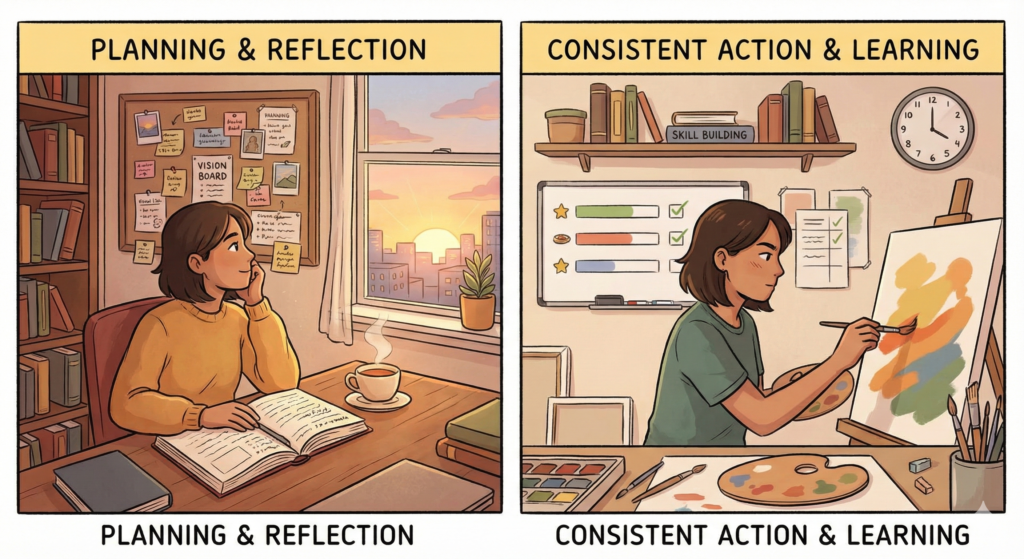
    person with daily habits

    Frequently Asked Questions (FAQ)

    1. How long does it take to form a new habit?

    The old “21 days” myth has been debunked. Research from University College London suggests it takes an average of
    66 days to build a new habit, though it can range from 18 to 254 days depending on the person and
    the difficulty of the habit.

    2. Can I try to implement all these habits at once?

    That is generally a recipe for failure. It is better to “habit stack.” Start with one small habit (e.g., drinking
    water first thing in the morning). Once that becomes automatic, add another. Consistency beats intensity.

    3. What if I am a “night owl”? Do I have to wake up early?

    Not necessarily. While many successful people are early risers, the principle is about control, not the
    clock. If you do your best work at 2 AM and can protect that time from distractions, that works too. The goal is
    uninterrupted, proactive time.

    4. What do I do when I slip up and miss a day?

    Follow the “Never Miss Twice” rule. Everyone messes up. The difference is that high achievers get back on track
    immediately. Missing one day is a mistake; missing two days is the start of a new (bad) habit.

    The Compound Effect of Consistency

    Achieving big dreams is rarely about a single heroic moment. It is about the quiet, unglamorous work done in the
    shadows. It is about the choice to wake up early when a warm bed beckons. It is about the choice to read a book when
    Netflix is easier. It is about the choice to keep going when results aren’t visible yet.

    These daily habits are the compound interest of self-improvement. Individually, they may seem small. But stacked over
    a year, five years, or a decade, they create an unassailable advantage. Start today. Pick one habit from this list,
    commit to it, and watch as your life begins to bend toward your biggest dreams.

  • How to Combat Procrastination

    How to Combat Procrastination

    How to Combat Procrastination When Chasing a Big Dream: The Ultimate Guide

    We all have that one Big Dream.

    Maybe it is writing a novel that defines a generation. Maybe it is launching a tech startup that disrupts an industry. Maybe it is achieving total financial freedom or mastering a new language. The dream is vibrant, exciting, and full of potential. It keeps you up at night with possibilities.

    But when the morning comes and it is time to work on that dream, something strange happens. You freeze.

    You reorganize your desk. You scroll through social media “looking for inspiration.” You answer unimportant emails. You convince yourself that you need to read just one more book on the subject before you start.

    This is the Paralysis of Magnitude.

    When a dream is big, it is also heavy. It carries the weight of expectation, the fear of failure, and the intimidation of a thousand unknown steps. Paradoxically, the more you want something, the harder it can be to start working on it.

    If you are currently stuck in this loop, you are not lazy, and you are not broken. You are dealing with a complex psychological response to high stakes. In this guide, we are going to deconstruct why we stall on our biggest ambitions and provide you with a battle-tested roadmap on how to combat procrastination and turn that massive dream into manageable reality.

    The Psychology: Why We Stifle Our Own Dreams

    To defeat the enemy, you must understand the enemy. Procrastination is often mislabeled as a time management issue. If you just bought a better planner or downloaded a new app, you’d be fine, right?

    Wrong. Procrastination is an emotional regulation problem, not a time management problem.

    When you look at your Big Dream, your brain’s limbic system (the ancient, emotional part) detects a threat.

    • The Threat of Failure: “What if I try and I’m not good enough?”
    • The Threat of Discomfort: “This is going to be hard and boring.”
    • The Threat of Identity Loss: “If I write this book and people hate it, who am I?”

    Your brain wants to protect you from these negative feelings. So, it urges you to do something that provides immediate dopamine and safety like watching Netflix or cleaning the kitchen. Procrastination is your brain’s misguided way of keeping you safe from the emotional pain of your own ambition.

    Understanding this is the first step to freedom. You aren’t fighting a lack of discipline; you are soothing a frightened brain.

    Strategy 1: The “Salami Slice” Method (Micro-Stepping)

    The sheer size of a Big Dream is what triggers the fear response. If your to-do list says “Build a Profitable Business,” your brain will shut down. It is too vague and too massive.

    You need to slice the task so thin that it becomes impossible to say no to it. This is often called the “Salami Slice” method.

    How to Apply It

    Don’t focus on the outcome; focus on the stupidly small entry point.

    • Instead of: “Write Chapter 1.”
    • Try: “Open the document and write three sentences.”
    • Instead of: “Create a marketing strategy.”
    • Try: “List 5 potential competitors.”
    • Instead of: “Go to the gym for an hour.”
    • Try: “Put on my running shoes.”

    When you lower the barrier to entry, you bypass the limbic system’s “fight or flight” response. Once you start, the physics of productivity takes over: an object in motion stays in motion. The hardest part is always the first two minutes.

    Action Item: Take your biggest, scariest task for today. Break it down into a step so small that it feels ridiculous. Do that step immediately after reading this section.

    Strategy 2: Forgive Your Past Self

    This might sound like advice for a therapy session, but it is scientifically proven productivity advice.

    A study conducted at Carleton University found that students who forgave themselves for procrastinating on studying for the first exam ended up procrastinating less for the second exam. Those who beat themselves up (“I’m so lazy,” “I always do this”) continued to procrastinate.

    The Guilt-Procrastination Loop

    1. You procrastinate.
    2. You feel guilty and ashamed.
    3. These negative emotions make the task feel even more painful and associated with negativity.
    4. You avoid the task again to avoid the negative feelings.

    To combat procrastination, you must break the loop. Acknowledge that you slipped up, accept that it is a human response to stress, and reset. Shame is a heavy backpack; you cannot run a marathon wearing it. Put it down.

    Action Item: Say this out loud: “I procrastinated yesterday. That is okay. Today is a fresh start, and my past actions do not dictate my future performance.”

    Strategy 3: Design Your Environment for Flow

    Willpower is a finite resource. If you have to use willpower to ignore your phone, ignore the TV, and ignore the clutter on your desk, you will have zero energy left for your Big Dream.

    You need to design an environment where doing the work is the path of least resistance.

    The Concept of Friction

    • Increase Friction for bad habits: Put your phone in another room. Unplug the TV. Log out of social media accounts.
    • Decrease Friction for your dream: Have your notebook open on your desk. Have your gym clothes laid out the night before. Have your research tabs open.

    If you want to write, your writing space should be a sanctuary. If you want to trade stocks or manage finances, your workspace should be clean and optimized for data analysis.

    Digital Minimalism

    For big dreams that require deep focus (Deep Work), digital distractions are the enemy.

    • Use tools like Freedom or Cold Turkey to block distracting websites during work hours.
    • Turn off all non-human notifications (news apps, game alerts).

    Action Item: Look at your workspace right now. Identify three things that are competing for your attention and remove them.

    Strategy 4: Utilize “Temptation Bundling”

    Katy Milkman, a behavioral economist at UPenn, coined the term “Temptation Bundling.” It involves coupling something you want to do with something you need to do.

    This is a powerful way to combat procrastination because it rewires the reward system. You stop dreading the task and start looking forward to the “bundle.”

    Examples of Bundling

    • The Podcast Bundle: You can only listen to your favorite true crime podcast while you are organizing your business receipts or cleaning the house.
    • The Coffee Shop Bundle: You can only drink that expensive $7 latte while you are sitting down to work on your coding project.
    • The Music Bundle: You have a specific playlist of your favorite high-energy songs that you only listen to when you are tackling your most difficult task.

    By linking a treat to the action, you bridge the gap between present pain and future gain.

    Action Item: Identify one “guilty pleasure” you enjoy (music, podcasts, specific snacks, a location) and create a rule that you can only access it when you are working on your Big Dream.

    Strategy 5: The “Fear Setting” Exercise

    We often procrastinate because we have a vague, undefined fear of what happens if things go wrong. Seneca, the Stoic philosopher, said, “We suffer more often in imagination than in reality.”

    Tim Ferriss popularized an exercise called Fear Setting. Instead of defining your goals, define your fears.

    The 3 Page Exercise

    1. Define: What is the absolute worst thing that could happen if you take action on this dream? Be specific. (e.g., “I lose $500,” “Someone laughs at my article”).
    2. Prevent: What could you do to prevent this from happening? (e.g., “Set a stop loss limit,” “Ask a friend to edit before publishing”).
    3. Repair: If the worst happened, how would you fix it? (e.g., “Pick up an extra freelance shift to make back the money”).

    Usually, when you write these down, you realize that the “worst-case scenario” is not fatal. It is uncomfortable, sure, but it is survivable. Once the monster in the closet is revealed to be just a pile of clothes, you can get back to work.

    Strategy 6: Embrace “B-Minus Work”

    Perfectionism is procrastination in a tuxedo. It looks fancy, but it stops you from moving.

    When chasing a Big Dream, we often feel that every step must be perfect. We think, “I can’t launch the website until the logo is award winning” or “I can’t invest until I know everything about the market.”

    This is a trap. Quantity leads to quality. The potter who throws 100 messy pots learns more than the potter who spends a month trying to make one perfect pot.

    Give yourself permission to do “B-Minus Work.”

    • Write a terrible first draft.
    • Launch a buggy beta version.
    • Record a podcast with mediocre audio.

    You can fix a bad page. You cannot fix a blank page.

    Action Item: Adopt the mantra “Done is better than perfect.” Set a timer for 20 minutes and produce something anything regardless of quality.

    Strategy 7: The Seinfeld Strategy (Don’t Break the Chain)

    Jerry Seinfeld was once asked by a young comic how to get better. His advice was simple: Write a joke every day.

    He suggested getting a big wall calendar and a red marker. Every day that you do the task (work on your dream), put a big red X over that day. After a few days, you’ll have a chain. Just keep at it and the chain will grow longer every day.

    “You’ll like seeing that chain, especially when you get a few weeks under your belt. Your only job next is to not break the chain.”

    Why It Works

    This visualizes your consistency. When you procrastinate, you aren’t just delaying work; you are breaking a streak that you have invested in. It gamifies the process.

    Action Item: Buy a physical calendar or use a habit-tracking app. Start your chain today.

    The Pain of Regret weighs Tons

    There are two types of pain in life: the pain of discipline and the pain of regret.

    The pain of discipline weighs ounces. It is the slight discomfort of turning off the TV, the brief anxiety of opening a blank document, or the fatigue of waking up an hour early.

    The pain of regret weighs tons. It is the heavy, crushing realization ten years from now that you had the potential, you had the time, and you had the dream, but you didn’t have the courage to start.

    Combating procrastination is not about becoming a robot. It is about respecting your own potential. It is about understanding that your Big Dream is worth the discomfort of the work.

    You have the strategies. You know about micro steps, environment design, and fear setting. The only thing missing is the action.

    Do not wait for motivation to strike. Motivation is a flaky friend who only shows up when the party is already started. Discipline is the loyal friend who helps you build the venue.

    Start today. Start small. But for the love of your future self, start.

    FAQ: Frequently Asked Questions

    1. Is procrastination a sign that I don’t really want my dream? Not necessarily. In fact, it’s often the opposite. We tend to procrastinate more on things that are important to us because the stakes feel higher. If you didn’t care, you wouldn’t feel the anxiety that causes procrastination. It is a sign of how much this matters to you.

    2. How do I distinguish between procrastination and burnout? Procrastination is avoiding a task despite having the energy to do other things (like play video games or clean). Burnout is a state of total emotional, physical, and mental exhaustion where you cannot bring yourself to do anything. If you are burned out, the solution is rest, not “productivity hacks.”

    3. What if my dream feels too big and I don’t know where to start? This is the “fog of war.” You don’t need to see the whole staircase to take the first step. Pick the one smallest action you can identify (e.g., “buy the domain name” or “read one article”). Action creates clarity. The next step will reveal itself only after you take the first one.

    4. Can I use fear as a motivator? Yes, but use it carefully. Fear of immediate consequences (like a deadline) works well for short bursts. However, chronic fear creates stress that leads to burnout. Try to shift your motivation from “Fear of Failure” (Moving Away) to “Desire for the Outcome” (Moving Toward).

    5. How does social media affect procrastination? Social media fractures your attention span and provides “cheap dopamine.” It tricks your brain into feeling rewarded without doing any work. It also fuels “Comparison Syndrome,” where you see others’ highlight reels and feel discouraged about your own progress, leading to more avoidance.

    6. I work better under pressure. Is that okay? Many people claim this, but studies show that work done under extreme time pressure is often more riddled with errors and less creative. Relying on adrenaline to finish tasks is a recipe for long-term stress. Try to create “artificial pressure” earlier in the process to get the benefits without the panic.

  • Turning Wish into Goal: 5-Step Practical Guide to Success

    Turning Wish into Goal: 5-Step Practical Guide to Success

    The 5-Step Guide to Turning Your Wish into a Goal (And Actually Achieving It)

    Step # Transformation Stage Key Output Frequency
    Step 1 Crystallize Vision Specific SMART Goal statement Initial setup
    Step 2 Define “Why” Emotional Anchor statement Initial setup
    Step 3 Reverse Engineer Path 1% Daily micro-actions Daily
    Step 4 Set Deadline & Urgency Target milestone date Weekly check-in
    Step 5 Execute, Measure & Pivot Weekly Review log Weekly

    Have you ever caught yourself staring out the window, thinking, “I wish I could do that”?

    We all have. We wish for financial freedom, we wish for a fitter body, we wish to write a book, or we wish to travel the world. But here is the harsh truth about wishes: a wish is passive. A wish waits for luck to strike. A wish assumes that the universe will align perfectly to drop success into your lap.

    A goal, however, is active. A goal is a wish with a spine. It has structure, a timeline, and a plan of attack.

    The gap between “I wish” and “I did” is often smaller than we think, but crossing it requires a shift in mindset and a rigorous strategy. If you are tired of daydreaming and ready to start executing, you are in the right place.

    In this comprehensive guide, we will break down the exact 5 step process for turning your wish into a goal. This isn’t just about writing a list; it is about fundamentally changing how you approach your desires to ensure success.

    Step 1: Crystallize the Vision (Move from Vague to Specific)

    The number one reason wishes die is ambiguity. When you say, “I wish I had more money,” your brain doesn’t know what to do with that information. Vague money wishes are too abstract. Without a clear target, you cannot aim.

    To turn a wish into a goal, you must apply the SMART criteria immediately. Your goal must be Specific, Measurable, Achievable, Relevant, and Time-bound.

    The Specificity Test

    Ask yourself: If I achieved this goal, what would it look like in a photograph?

    • The Wish: “I want to get in shape.”
    • The Goal: “I will reduce my body fat percentage to 15% and run a 5k in under 25 minutes.”
    • The Wish: “I want to be rich.”
    • The Goal: “I will increase my passive income to $2,000 per month through dividend stocks and affiliate marketing.”

    When you define the specific outcome, you activate the Reticular Activating System (RAS) in your brain. This is the filter that helps you focus on what matters. Suddenly, you start seeing opportunities that align with your specific goal because you have finally told your brain exactly what you are looking for.

    Action Item: Write down your wish. Now, rewrite it so that a stranger could read it and know exactly what success looks like without asking you any questions.

    Step 2: Define Your “Why” (The Emotional Anchor)

    Logic makes us think, but emotion makes us act.

    You can have the most perfectly structured plan on paper, but if you don’t have a burning emotional connection to the result, you will quit the moment things get difficult. And things will get difficult.

    This step is about digging deep to find your Emotional Anchor. This is the underlying reason that will keep you moving forward when you are tired, stressed, or unmotivated.

    The “5 Whys” Technique

    To find your anchor, ask “Why?” five times.

    • Goal: I want to start an online business.
      1. Why? To make extra money.
      2. Why? So I can quit my 9 to 5 job.
      3. Why? Because I hate having a boss and a rigid schedule.
      4. Why? Because I want to be present for my children as they grow up.
      5. Why? Because my father was always working when I was a kid, and I don’t want to repeat that cycle.

    Now we have the truth. You aren’t just building a business for money; you are building it to break a generational cycle and be a better parent. That is a goal worth fighting for.

    Action Item: Journal your “5 Whys.” Once you find the core emotional reason, write it on a sticky note and place it where you will see it every single morning.

    Step 3: Reverse Engineer the Path (The Action Plan)

    A goal without a plan is just a wish. This is the stage where most people get overwhelmed. A massive goal like “Write a Novel” feels insurmountable. The secret is Reverse Engineering.

    Start from the finish line and work backward to today.

    Breaking It Down

    Imagine your goal is a mountain. You cannot jump to the summit. You have to establish base camps.

    1. The Macro Goal: Launch a website in 6 months.
    2. Monthly Milestone: Month 1: Choose niche and domain. Month 2: Set up hosting and design. Month 3: Write 10 articles…
    3. Weekly Target: This week, I need to research 5 potential niches.
    4. Daily Habit: Today, I will spend 30 minutes reading about SEO. Setting small daily habits is what ultimately leads to major accomplishments.

    By the time you get to the daily habit, the task is no longer scary. It is manageable. You aren’t “building a business” today; you are simply “registering a domain name.”

    The 1% Rule

    Do not underestimate the power of compound effort. Improving by just 1% every day results in a 37x improvement over the course of a year. Focus on the micro-steps.

    Action Item: Create a roadmap. Break your goal into 3 major milestones. Then, break the first milestone into weekly tasks. Finally, decide what is the one thing you can do in the next 24 hours to start.

    Step 4: Set a Deadline and Create Urgency

    Parkinson’s Law states: “Work expands to fill the time available for its completion.”

    If you give yourself a year to clean your garage, it will take a year. If you give yourself 3 hours because guests are coming over, it will take 3 hours.

    Wishes are open-ended. Goals have deadlines. Without a deadline, procrastination is inevitable. You need to create a sense of urgency, even if it is artificial.

    Types of Deadlines

    1. Hard Deadlines: These are external. Example: Signing up for a marathon. The race date won’t change just because you didn’t train.
    2. Soft Deadlines: These are internal. Example: “I want to finish this chapter by Friday.”

    To make soft deadlines effective, you need accountability stakes.

    • The Financial Stake: Give a friend $50. If you don’t hit your weekly goal, they keep the money. If you do, you get it back.
    • The Social Stake: Post your goal publicly on social media. The fear of public failure is a powerful motivator.

    Action Item: Open your calendar. Mark the “Done Date.” Now, mark the halfway checkpoint. Treat these dates as unmovable appointments with your future self.

    Step 5: Execute, Measure, and Pivot (The Feedback Loop)

    The plan you made in Step 3 is a hypothesis. You won’t know if it works until you test it.

    Many people treat their plan as a rigid document. If they miss one day, they feel they have “failed” and abandon the goal entirely. This is the wrong approach. You must adopt the mindset of a scientist.

    The Weekly Review

    You must schedule a meeting with yourself once a week (Sunday evenings act as a great time for this). During this review, ask three questions:

    1. What did I accomplish this week? (Celebrate the wins).
    2. Where did I fall short? (Identify the obstacles).
    3. What do I need to change for next week? (Pivot the strategy).

    If you aimed to go to the gym 5 times but only went twice because you were too tired after work, don’t beat yourself up. Pivot. Change the plan to go in the morning before work.

    The path to a goal is never a straight line. It is a zigzag. The most successful people are not the ones who never fail; they are the ones who can adjust their course the fastest.

    Action Item: Set a recurring alarm on your phone for a “Weekly Goal Review.” Never skip this meeting.

    Bonus: Overcoming the “Valley of Despair”

    Every goal follows an emotional cycle.

    1. Uninformed Optimism: The beginning. You are excited! “This will be easy!”
    2. Informed Pessimism: You realize it’s hard work. “This isn’t fun anymore.”
    3. The Valley of Despair: The point where most people quit. You see the effort but no results yet.
    4. Informed Optimism: You start seeing small wins. You get your rhythm back.
    5. Success/Completion: The goal is a habit or achieved.

    When you are in the Valley of Despair, remember that it is a natural part of the process. It is not a sign that you should stop; it is a sign that you are about to breakthrough.

    Conclusion

    Turning a wish into a goal is not magic; it is mechanics. It requires taking the ethereal dream floating in your head and forging it into reality through specificity, emotional connection, planning, urgency, and consistent review.

    Remember, the time will pass anyway. Five years from now, you will either say, “I wish I had started,” or “I am so glad I did.”

    You have the 5 step framework. The wish is in your head. The pen is in your hand. The rest is up to you.

    Ready to start? Leave a comment below with the ONE wish you are turning into a goal today. Let’s hold each other accountable.

    FAQ: Frequently Asked Questions

    1. What is the main difference between a wish and a goal? A wish is a desire without a plan (e.g., “I wish I were wealthy”). A goal is a specific objective with a deadline and an actionable plan (e.g., “I will save $10,000 for a down payment by December 31st”). A goal implies responsibility and action.

    2. How many goals should I set at once? It is recommended to focus on one to three major goals at a time. Trying to overhaul your finance, health, career, and relationships simultaneously often leads to burnout. Focus on one “Keystone Goal” that, if achieved, might help the other areas of your life naturally improve.

    3. What should I do if I miss my deadline? Don’t panic and don’t quit. A missed deadline is just data. Analyze why you missed it. Was the deadline unrealistic? Did unexpected life events occur? simply reset the deadline based on your current reality and keep moving. Progress is better than perfection.

    4. How do I stay motivated when I don’t see results immediately? Focus on lead measures (actions you take, like writing 500 words/day) rather than lag measures (results, like selling 1,000 books). If you consistently hit your lead measures, the results will eventually catch up. Also, revisit your “Why” (Step 2) to reconnect with your purpose.

    5. Is it okay to change my goal halfway through? Absolutely. Flexibility is key. If you realize halfway through that the goal no longer aligns with your values or life direction, it is smarter to pivot or abandon it than to continue just for the sake of finishing. However, ensure you aren’t quitting just because it’s difficult.