Can You Manifest for Others? The Ethics of Wishing
Ever wondered if you can use the law of attraction to help friends, family, or even strangers achieve their dreams? While the idea feels powerful, it also raises important ethical questions.
Research shows that when we consciously channel positive energy toward others, the brain releases oxytocin, fostering trust and social bonding. This scientific backing reinforces the spiritual practice, making it a holistic approach to collective wellbeing.
Why Manifesting for Others Matters
Manifestation isn’t just a personal tool; it can be a catalyst for collective growth. When you channel intention toward another person, you create a bridge between your energy and their reality, potentially accelerating their goals.
Respecting autonomy is crucial. By framing intentions as supportive rather than controlling, you align with ethical standards and avoid the pitfalls of manipulation. Transparent intentions also nurture deeper relationships.
Intentionality and Responsibility
Setting an intention for someone else requires deep respect for their free will. It’s essential to ask: Am I imposing my desires onto them? The answer determines whether your practice supports or undermines their autonomy.
Obtaining consent not only honors free will but also amplifies the manifesting power. When both parties willingly engage, the shared vibration becomes stronger, increasing the likelihood of the desired outcome.
Consent is Key
Before you begin, obtain clear consent. A simple conversation—“Would you like me to focus my manifestation practice on your career goal?”—ensures both parties are aligned and prevents unwanted influence.
These practical steps provide a roadmap for ethical manifestation, ensuring that your energy is directed responsibly and effectively.
Practical Steps to Ethical Manifestation
Follow these guidelines to keep your practice ethical and effective.
Clear, measurable goals prevent ambiguity. For example, instead of “I want success,” specify “I want to secure three new clients by June 30th,” which creates a concrete target for the universe to align with.
1. Clarify the Goal Together
Collaborate with the person to define a specific, measurable outcome. Vague wishes can lead to misinterpretation and frustration.
Neutral language removes any hint of coercion. Using phrases like “May you attract” keeps the focus on the individual’s agency while still channeling positive intention.
2. Use Neutral Language
Frame your affirmations in a way that supports the other’s agency. Example: “May [Name] confidently attract the right opportunities for their new business.”
Emotional boundaries protect your own energy. Practice mindfulness techniques such as deep breathing or meditation after each session to release attachment and maintain balance.
3. Maintain Emotional Boundaries
While empathy fuels your energy, avoid becoming overly attached to the result. Trust the process and release any need for control.
Regular reflection helps you stay aligned with the other’s evolving desires, preventing misdirection of energy and ensuring continued relevance of your intentions.
4. Reflect and Adjust
Regularly check in with the person you’re supporting. If their desires change, adapt your focus accordingly.
Common Ethical Dilemmas
Below are scenarios you might encounter and how to navigate them.
Manifesting for a Partner’s Decision
Influencing a partner’s major life choices can blur lines of consent. The safest approach is to focus on your own clarity and let them decide.
Group Manifestation for a Community Project
When a whole community aligns on a shared vision, collective intent amplifies impact. Ensure everyone’s voice is heard and represented.
Why Writing a Letter to Yourself Is a Powerful Tool for Recovery
In the heat of an urge, our rational mind often takes a backseat to the impulsive, dopamine-seeking part of our brain. This is especially true when dealing with the cycle of gambling. One of the most effective ways to bridge the gap between your present struggle and your future freedom is through a therapeutic letter to yourself.
By using the principles of mindset shifts and cognitive reflection, this exercise helps you pause, reconnect with your “why,” and create a tangible contract with the person you are becoming. This isn’t just about willpower; it’s about rewiring your response to triggers through intentionality.
The Science of Therapeutic Writing
Research in psychology suggests that externalizing your thoughts through writing helps reduce the intensity of cravings and provides a sense of control. When you write to your future self, you are practicing a form of visualization and manifestation. You are essentially manifesting a reality where you are no longer bound by the urge to bet.
By engaging with your emotions on paper, you move from a state of “reacting” to a state of “observing.” This detachment is key to overcoming any addictive behavior and aligns perfectly with the role of gratitude and self-compassion in personal growth.
How to Write Your “Anti-Bet” Letter: A Step-by-Step Guide
Step 1: Find a Quiet, Safe Space
To make this exercise effective, you need to be honest. Find a place where you won’t be interrupted. Treat this as a sacred ritual of self-care. Just as you might prepare for a morning affirmation session, create an environment that fosters reflection.
Step 2: Acknowledge the Pain of the Past
Don’t shy away from the truth. Remind yourself how you felt after the last loss. Use descriptive language: the pit in your stomach, the anxiety, the broken promises. This isn’t about shaming yourself, but about providing a realistic contrast to the temporary “high” of a bet.
Step 3: State Your “Why” Clearly
Why do you want to stop? Is it for your family? Your financial freedom? Your mental peace? Be specific. Your “why” is the anchor that will keep you steady when the waves of a craving hit. If your goal is long-term stability, write it down as if it is already happening.
Step 4: Describe the Future Version of You
Use the Law of Assumption here. Describe the person you are when you haven’t bet for 30, 60, or 365 days. How do you wake up in the morning? How much more energy and mental clarity do you have? Visualize the freedom of having control over your own choices.
Step 5: The Emergency Instructions
Tell your future self exactly what to do when the urge returns. “When you feel like betting, I want you to go for a walk, call [Name], or re-read this letter.” Give yourself a clear exit strategy.
Sample Letter Structure
Here is a template you can adapt for your own therapeutic letter:
The Opening: “Dear [Your Name], I am writing this to you because I care about your future…”
The Reminder: “Remember that feeling on [Date]? We don’t want to go back there.”
The Vision: “You deserve a life of abundance and peace. Right now, your bank account is [Status] and your mind is [Status]…”
The Action: “Instead of placing that bet, take a deep breath and remember our promise.”
Common Mistakes to Avoid
Being Too Harsh
If you write from a place of self-hatred, your brain will want to escape that feeling—often by returning to the very habit you’re trying to break. Write from a place of loving authority. You are a parent guiding a child, not a judge sentencing a criminal.
Focusing Only on Money
While financial loss is a major trigger, the emotional and spiritual loss is often deeper. Focus on the mindset and relationship benefits of staying bet-free. Use journaling techniques to explore these deeper layers.
Tips to Amplify the Effectiveness
Keep it accessible: Keep a physical copy in your wallet or a digital copy on your phone’s home screen.
Read it daily: Don’t wait for a crisis. Read it during your morning routine to reinforce your commitment.
Update it: As you achieve small wins, update the letter to reflect your growing strength.
Yes. Therapeutic writing is a versatile tool for any behavior you wish to change. It works by engaging the prefrontal cortex, which is responsible for logical decision-making.
How long should the letter be?
There is no set length, but aim for enough detail to evoke a strong emotional response. Usually, 500 to 800 words is a good range for deep reflection.
What if I relapse after writing the letter?
A relapse is a sign that the strategy needs adjustment, not that you’ve failed. Read the letter again, add a new section about what you’ve learned from the setback, and recommit. Progress is a journey, not a destination.
Final Thoughts
Breaking the cycle of betting requires more than just “stopping.” It requires transforming your relationship with yourself. Writing a letter to your future self is a powerful way to claim your power back from the impulse and manifest a life of integrity and peace.
Start your letter today. Your future self will thank you for the courage you showed in this moment.
There is a unique magic to the autumn season. While January gets all the credit for “new beginnings,” Fall holds a
potent, transformative energy of its own. It is the season of harvest, of turning inward, and of preparation. As the
leaves surrender to the ground and the air turns crisp, we are naturally inclined to take stock of our lives.
However, Fall also signals the impending arrival of the Holiday Season—a time often characterized by chaos, social
obligations, and the derailment of our personal goals. If we are not careful, the final quarter of the year can slip
through our fingers, leaving us feeling depleted rather than accomplished when the New Year arrives. This article is
your guide to setting “Fall Intentions”—a strategic approach to finishing the year strong while honoring the need
for rest and festive joy. (For further reading, explore our guide on spring cleaning your mind).
The “September New Year” Effect (and how to use it in December)
Even if we haven’t been in school for decades, our brains are wired to view Fall as a reset button. The “Fresh Start
Effect” is a psychological phenomenon where temporal landmarks (like the start of a semester or a season) allow us, as explored in Wharton research on the Fresh Start Effect,, as explored in Wharton research on the Fresh Start Effect,
to separate our current selves from our past failures. We can harness this energy to reassess our annual goals.
Before the holiday madness truly sets in, take a moment to look at the resolutions you set back in January. Which
ones are dead in the water? Which ones are agonizingly close to completion? Now is the time for a “Merciless Audit.”
Be honest. If you haven’t started learning French by now, you probably won’t do it during the Christmas rush. Drop
it. Clear the mental bandwidth. Focus solely on the 1-2 goals that are attainable and impactful in the remaining
weeks of the year. (For further reading, explore our guide on finding the best time of day to set intentions).
The Art of Strategic De-loading
Athletes use a technique called “de-loading”—reducing the intensity of training to allow for recovery and growth. The
Holiday Season should be your life’s de-load period. Yet, most of us try to increase our load, adding
shopping, hosting, and traveling on top of our full-time jobs and existing goals.
Fall intentions are about pre-deciding what you will sacrifice. You cannot have it all. If you want
to enjoy a stress-free holiday with your family, you might need to put your side-hustle on “maintenance mode” rather
than “growth mode” for December. This isn’t quitting; it’s strategic pacing. By consciously lowering your
expectations in certain areas, you prevent the guilt that comes from inevitably falling short.
Setting Holiday-Specific Micro-Goals
Instead of fighting against the current of the holidays, set goals that swim with it. Intentions for this
season should be nurturing rather than demanding.
Connection over Perfection: Instead of “Throw the perfect Thanksgiving dinner,” try “Spend 30
minutes of quality undistracted time with parents.”
Mindful Consumption: Instead of strict dieting (which often fails during holidays), aim for
“Drink a glass of water between every festive beverage.”
Financial Boundaries: Set a strict “Gift Budget” now, before the emotional pressure of sales
hits.
“Hygge” Productivity
The Danish concept of Hygge (coziness, contentment) doesn’t have to mean laziness. You can practice “Hygge
Productivity.” This means creating an environment that makes working on your goals feel like a treat rather than a
chore.
If you have writing to do, do it under a warm blanket with a candle lit. If you have admin work, do it with a cup of
hot cider. By associating your tasks with sensory pleasure, you reduce the friction of starting them during the
dark, cold evenings. This alignment with the season helps maintain momentum without the jarring harshness of “grind
culture.”
The “Pre-Mortem” Strategy
Stoic philosophers practiced premeditatio malorum—the premeditation of evils. Before the holiday season
enters full swing, perform a “Pre-Mortem.” Fast forward to January 1st and imagine you are exhausted, broke, and
regretful. Ask yourself: “What went wrong?”
Did you say “yes” to too many parties? Did you abandon your sleep schedule? Did you overspend? By identifying these
failure points now, you can set “Guardrail Intentions” to prevent them. For example, “I will only attend
two social events per week” or “I will leave my credit card at home when window shopping.”
Transitioning into Winter: The Wintering Mindset
Fall is the bridge to Winter. In nature, winter is a time of dormancy. Trees do not die; they conserve energy to
survive the frost. We often fear this dormancy. We feel we must be blooming 12 months a year.
Your Fall Intentions should include permission to “Winter.” This means accepting that your energy levels will be
lower. It means accepting that it gets dark at 5 PM, and that’s a biological cue to rest, not a sign of weakness. By
aligning your expectations with your circadian rhythms, you avoid the burnout that creates the dreaded “January
Hangover.”
3 Rituals for the Season
1. The Harvest List
Write down everything you have achieved, learned, or overcome so far this year. We often focus on the gap between
where we are and where we want to be. The Harvest List forces you to focus on the gain. It builds confidence.
2. The Solstice Review
Use the Winter Solstice (the shortest day of the year) as a ritualistic turning point. Use this darkest day to light
a candle and formally “put to bed” the goals you are carrying over to next year, releasing the pressure to finish
them now.
3. The “No” Template
Draft a polite but firm text message template for declining invitations. Having this script ready reduces the
emotional labor of setting boundaries in the heat of the moment.
Frequently Asked Questions (FAQ)
1. Is it too late to set goals in Fall?
Never. In fact, “End-of-Year Sprints” can be highly effective because there is a built-in deadline (December 31st).
Short-term, urgent goals often see higher completion rates than vague yearly resolutions.
2. How do I balance diet goals with holiday food?
Adopt the 80/20 rule (sound familiar?). Eat nutritiously 80% of the time, and enjoy the holiday treats 20% of the
time without guilt. Goal rigidity during holidays often leads to bingeing. Flexibility leads to sustainability.
3. What if I feel sad during the holidays?
Seasonal Affective Disorder (SAD) and holiday blues are real. Your Fall Intentions should include mental health
safeguards: Vitamin D, therapy appointments, or scheduled “downtime” away from family stressors. Prioritize your
mental hygiene above social expectations.
4. Should I start my 2026 planning now?
Lightly, yes. It is helpful to have a rough sketch of the coming year so you don’t wake up on January 1st panicking.
However, don’t let planning for the future rob you of the present joy of the season.
Conclusion: Finishing with Grace, Not Grunt
The end of the year does not have to be a crash landing. By setting thoughtful Fall Intentions, you can glide into
the New Year with a sense of peace and completion. Remember, the goal of the holiday season is not to be the most
productive person in the room; it is to be the most present.
Use these weeks to harvest your wins, shed your dead weight, and prepare your soil for the coming spring. Be kind to
yourself. The days may be getting shorter, but your inner light can burn just as bright if you protect it.
Spring is universally recognized as the season of renewal. We open the windows to let the fresh air in, we scrub the
floors, and we donate bags of old clothes to charity. We understand intuitively that our physical spaces accumulate
dust and clutter over time, and that a deep clean is necessary to restore a sense of peace and order to our homes.
However, we rarely apply this same logic to our most important living space: our mind. Just like a
closet stuffed with ill-fitting coats, our minds get cluttered with outdated ambitions, expired “shoulds,” emotional
baggage, and half-finished projects. This mental clutter takes up valuable real estate, leaving no room for new,
vibrant wishes to take root. If you are feeling stuck, overwhelmed, or uninspired, the solution might not be to add
more goals, but to clean out the old ones. Welcome to the art of Spring Cleaning Your Mind. (For further reading, explore our guide on setting seasonal fall intentions).
The Cost of Mental Clutter
Why is a cluttered mind so dangerous? Because mental energy is finite. Every uncompleted task, every lingering
regret, and every vague “someday” goal you hold onto acts like a background app running on your phone. It drains
your battery, even if you aren’t actively using it. This is known in psychology as the Zeigarnik Effect:
uncompleted tasks create a state of cognitive tension. To understand how this drains your focus, check out the Psychology Today guide on mental decluttering.
When your wish list is crowded with desires from five years ago—desires that no longer align with who you are
today—you create a “debt” of guilt. You look at your list and feel like a failure, not because you aren’t achieving,
but because you are measuring yourself against a version of yourself that no longer exists. Spring cleaning is the
act of debt forgiveness. It is about closing those background apps so you can run at full speed again. (For further reading, explore our guide on applying the 80/20 rule to your wish list).
Phase 1: The Great Excavation (The Braindump)
You cannot clean a mess you cannot see. The first step in physical cleaning is often emptying the drawers onto the
floor. In mental cleaning, we do this with a “Braindump.” Incorporating this into your daily habits can clear mental fog. Incorporating this into your daily habits can clear mental fog.
Set aside one hour. Turn off your phone. Take a blank sheet of paper or open a fresh document. Now, write down
everything. And we mean everything:
Current big goals (e.g., “Run a marathon”).
Nagging chores (e.g., “Fix the leaky faucet”).
Vague aspirations (e.g., “Learn to paint”).
Social obligations (e.g., “Call Aunt Marie”).
Guilts and regrets (e.g., “I should have taken that job”).
Do not edit. Do not judge. Just get it out of your head and onto the external “hard drive” of the paper. You will
likely feel a sense of immediate physical relief just by externalizing the chaos.
Phase 2: The Sort (Keep, Toss, Archive)
Now that the mess is on the floor, we must sort it. Go through every item on your list and assign it to one of three
categories. Be ruthless. This is where the magic happens.
Category A: The Trash (The “No Longer Me” Pile)
These are the wishes that belonged to a past version of you. Maybe 22-year-old you wanted to be a DJ, but 32-year-old
you values quiet evenings. Maybe you thought you “should” learn coding because it pays well, but you hate computers.
Throw these away. Literally cross them out. Acknowledge that it was a nice thought, thank it for its service, and
let it go. You are not quitting; you are evolving.
Category B: The Archive (The “Not Now” Pile)
These are things you genuinely want to do, but not right now. Trying to do them now is causing stress. Maybe
you want to travel to Japan, but you have a newborn baby. Put this on a “Someday/Maybe” list. Store it away in a
drawer. You are giving yourself permission to ignore it for the next 6-12 months without guilt. It is safe; it isn’t
gone, it’s just hibernating.
Category C: The Keepers (The “Hell Yes” Pile)
What remains should be a small, shiny list of things that excite you today. These are the wishes that make
your heart race. They align with your current values and resources. This is your refreshed list.
Phase 3: Deep Scrubbing (Refining the Keepers)
Just because you kept a goal doesn’t mean it doesn’t need a polish. “Get healthy” is a dusty, vague goal. Scrub it
until it sparkles with clarity. Change it to “Walk 30 minutes every morning” or “Eat a vegetable with every dinner.”
Ensure every keeper goal passes the “Why” test. Why do you want this? If the answer involves impressing others or
meeting societal standards, it might need to go back to the Trash pile. If the answer involves joy, growth, or
service, it is ready for the mantelpiece.
Phase 4: Emotional Dusting (Forgiveness)
We often clutter our minds with grudges—against others, but mostly against ourselves. “I should have started sooner.”
“I wasted so much time.” This emotional dust coats everything and makes even new goals look drab.
Spring cleaning requires a ritual of forgiveness. Forgive yourself for the time you didn’t productivity. Forgive
yourself for the abandoned projects. Accept that you did the best you could with the awareness you had. When you
wipe away the grime of self-judgment, you reveal the bright surface of possibility underneath.
Phase 5: Digital Decluttering
Our minds are tethered to our devices. A cluttered digital life leads to a cluttered mind. You cannot have clear
thoughts if your visual field is constantly bombarded by noise.
Unfollow mercilessly: If an account makes you feel inadequate, jealous, or annoyed, unfollow.
Curate a feed that inspires and educates.
Inbox Zero (or close to it): unsubscribing from newsletters is a spiritual act. It reclaims
your attention.
Desktop cleanup: A chaotic computer desktop is a visual representation of chaos. Organize your
files. Create a serene digital workspace.
Maintenance: Keeping the House Clean
Once you have done the deep clean, how do you keep it that way? Adopt the “one in, one out” rule. If you want to add
a new major commitment to your life, you must remove an old one. This respects the physical reality of time.
Also, schedule “mini-cleans.” spend 10 minutes every Sunday evening reviewing your week and clearing out mental
cobwebs. This prevents the clutter from reaching critical mass again.
Frequently Asked Questions (FAQ)
1. How do I know if a goal belongs in the “Trash” or the “Archive”?
Ask yourself: “If I knew no one would ever know I achieved this, would I still want it?” If the answer is yes, but
the timing is wrong, Archive it. If the answer is no, Trash it.
2. Isn’t giving up on goals a sign of failure?
Seth Godin talks about “The Dip.” There is a difference between quitting because it’s hard (which you shouldn’t do)
and quitting because it’s a dead end (which you must do). Strategic quitting is a success skill. It frees
up resources for the battles you can actually win.
3. Can I do this more than once a year?
Absolutely. Many successful people do a quarterly review (every 90 days) to realign their compass. The seasons are
just a helpful reminder, but you can spring clean in November if that is when you need it.
4. What if I end up with an empty list?
That is terrifying and wonderful. It means you have a blank canvas. Do not rush to fill it. Sit with the emptiness.
Let your genuine curiosity emerge. boredom is often the prelude to creativity.
Conclusion: The Joy of Lighter Living
When you finish spring cleaning your home, there is a distinct feeling of lightness in the air. The sun seems to
shine a little brighter through the clean windows. The same happens when you clean your mind.
By letting go of the heavy, dusty expectations that no longer serve you, you create space for serendipity, for joy,
and for the new wishes that are waiting to find you. You stop dragging the past behind you and start stepping
lightly into the future. So grab your mental broom. It’s time to sweep.
Using the 80/20 Rule to Prioritize Your Most Important Wishes
In a world overflowing with possibilities, it is all too easy to find ourselves drowning in a sea of desires. We want to travel the world, learn three new languages, start a business, get in the best shape of our lives, spend more time with family, read 50 books a year, and somehow also find time to relax. Our wish lists grow endlessly, filled with everything from life-changing ambitions to fleeting fancies. But here is the harsh truth: trying to do everything often means accomplishing nothing.
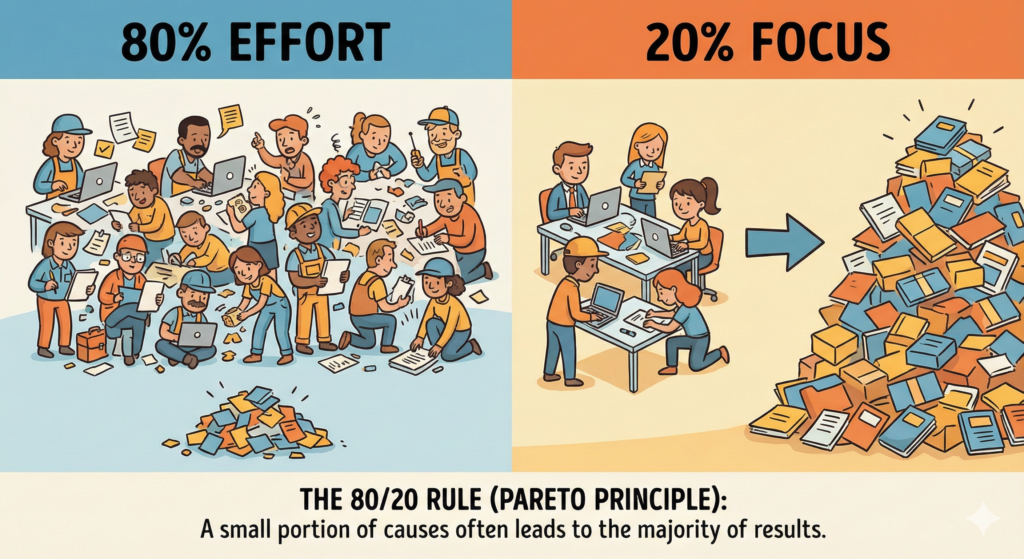
This is where the 80/20 Rule, also known as the Pareto Principle, becomes a game-changer. It is not just a productivity hack for CEOs or a statistical observation for economists; it is a profound philosophical razor that can slice through the noise of your life and reveal what truly matters. By applying the 80/20 rule to your wishes, you can identify the vital few desires that will bring you the vast majority of your happiness and fulfillment. (For further reading, explore our guide on turn your wishes into concrete goals).
Understanding the Pareto Principle
The Pareto Principle was named after Vilfredo Pareto, an Italian economist who, in 1896, noticed a peculiar imbalance in wealth distribution: approximately 80% of the land in Italy was owned by only 20% of the population. Upon further observation, he found this ratio popped up everywhere. In his garden, 20% of the peapods produced 80% of the peas. In business, 80% of sales often come from 20% of clients. In software, 80% of errors are caused by 20% of bugs.
The core concept is simple: inputs and outputs are rarely equal. A small minority of causes, inputs, or efforts usually lead to a majority of the results, outputs, or rewards. When we apply this to our personal lives and our lists of wishes, the implication is staggering. It suggests that of all the things you think you want, only a small fraction—the “vital few”—are actually responsible for the deep sense of satisfaction and joy you are seeking. The rest—the “trivial many”—are likely distractions, borrowed desires, or things that sound nice but won’t actually move the needle on your happiness. (For further reading, explore our guide on avoiding burnout while setting boundaries). (See also: Encyclopedia Britannica guide to the Pareto Principle).
The Trap of the Infinite Wish List
Why do we struggle to prioritize? Often, it is because we operate under the illusion that we have infinite time and energy. We treat our lives like a buffet where we can put everything on our plate. But life is not a buffet; it is a prix fixe menu where you have to make choices. When you load your plate with 50 different items, you end up with a mess of flavors and indigestion. You do not savor anything.
When you have 20 “top priority” wishes, you have zero priorities. Your energy is scattered. You make an inch of progress in a dozen directions, rather than a mile of progress in the one direction that matters. This dilution of effort leads to burnout, frustration, and the sinking feeling that despite being busy, you are not actually getting anywhere. The 80/20 rule grants you permission to stop trying to be everything to everyone (including yourself) and instead double down on the things that resonate most deeply with your core self.
Step-by-Step: Applying the 80/20 Rule to Your Wishes
So, how do we practically apply this abstract economic theory to the emotional and personal realm of our dreams? It requires a deliberate process of auditing, scoring, and eliminating. Here is a guide to decluttering your soul’s inbox.
1. The Grand Audit
First, you must capture everything. Take a piece of paper or open a blank document. Write down every single wish, goal, dream, or vague desire currently occupying mental real estate. “Learn to play guitar.” “Buy a vacation home.” “Get a promotion.” “Clean the garage.” “Visit Japan.” Don’t filter yet. If it’s on your mind, it goes on the list.
You might end up with 20, 50, or even 100 items. Seeing them all in one place can be overwhelming, but it is necessary. You cannot organize clutter until you can see the extent of it.
2. Calculating the “Happiness ROI”
Now, look at your list. If the Pareto Principle holds true, roughly 20% of these items will contribute to 80% of your future happiness and fulfillment. If you have 25 items on your list, that means only 5 of them really matter.
Ask yourself for each item: If I could only achieve this one thing and nothing else on the list, how satisfied would I be with my year/life?
You will start to notice that some wishes are “foundational.” For example, “Improving my health” might enable you to enjoy everything else. “Repairing my relationship with my sibling” might remove a massive weight from your shoulders, changing your daily mood. In contrast, “Buying a new 4K TV” might provide a spike of dopamine, but its long-term contribution to your fulfillment is negligible.
3. Identify the “Domino Wishes”
Tim Ferriss often talks about “domino” actions—things that, if done, make everything else easier or unnecessary. Look for wishes that have a domino effect. Perhaps “Starting a side business” (Wish A) provides the extra income to “Travel more” (Wish B) and “Pay off debt” (Wish C). In this case, focusing on Wish A addresses the others indirectly. The 20% often consists of these high-leverage wishes.
4. The Pain of Elimination
Here is the hard part. Once you have identified your top 20%, you must look at the bottom 80%. These are not necessarily “bad” wishes. They are often “good” wishes. They are things you genuinely like. But they are the enemy of the “great.”
Warren Buffett famously advised his pilot to list his top 25 goals, circle the top 5, and then put the other 20 on an “Avoid At All Costs” list. You don’t just put them on the back burner; you actively avoid them because they are the seductive distractions that will eat up the time you need for your top 5. You have to be willing to mourn the loss of those alternative futures to fully inhabit the one you are choosing.
Living in the 20% Zone
When you focus your resources—time, money, emotional bandwidth—on just your top wishes, magic happens. You move faster. You achieve a state of “flow” more easily because you aren’t constantly context-switching between disparate goals. If your top wish is to write a novel, and you cut out the hours spent researching pottery classes (a bottom 80% wish) or browsing real estate (another bottom 80% wish), you suddenly find you have the time to actually write.
Furthermore, the 20% are usually the wishes that align most closely with your values. The other 80% are often influenced by society, advertising, or peer pressure. By stripping those away, you aren’t just becoming more productive; you are becoming more authentic.
Overcoming the Fear of Missing Out (FOMO)
The biggest psychological barrier to the 80/20 rule is FOMO. “But what if I really discover I love pottery?”“What if I regret not learning Italian?”
The antidote to FOMO is JOMO: the Joy of Missing Out. There is a deep, resonant joy in commitment. When you commit to your top wishes, you go deep rather than wide. The satisfaction of mastery and completion outweighs the shallow thrill of novelty. Remember, prioritizing the 20% doesn’t mean you can never do the other things. It just means you aren’t doing them now. You are sequencing your life instead of trying to run everything in parallel.
Frequently Asked Questions (FAQ)
1. Can I have different 80/20 lists for different areas of life?
Yes. You can apply this rule separately to your career, your relationships, and your hobbies. However, be careful not to create so many sub-categories that you end up with a crowded plate again. Ideally, you should have one master list for your overall time allocation.
2. What if my top 20% wishes keep changing?
It is normal for desires to evolve, but if they change weekly, you might be stuck in the dreaming phase rather than the doing phase. Try to stick with your top selection for at least 3 to 6 months to give yourself a chance to see results before re-evaluating.
3. Is the ratio always exactly 80/20?
No, it is a heuristic, not a law of physics. It could be 90/10 or 70/30. The point is the inequality: a small number of inputs creates the majority of value. Don’t get hung up on the math; focus on the concept of leverage.
4. Isn’t this approach selfish?
Prioritizing your wishes doesn’t mean ignoring your responsibilities to others. In fact, many people find that “Being a better parent” or “Contributing to my community” lands squarely in their top 20%. By clearing out the trivial clutter, you often have more energy to be present for the people who matter most.
The Courage to Choose
Using the 80/20 rule to prioritize your wishes is ultimately an act of courage. It requires the bravery to say “no” to good things so that you can say “yes” to the best things. It forces you to confront the finitude of your time and make peace with it.
Take a look at your list today. Find those golden few, the wishes that make your heart race, the ones that align with your deepest purpose, the ones that, if fulfilled, would make you feel that your life has been well-spent. Circle them. Cherish them. And then, gently but firmly, let the rest go. Your future self, unburdened and fulfilled, will thank you for it.