Tag: Productivity

  • Top 10 Inspirational Quotes for Monday to Fuel Your Week

    Top 10 Inspirational Quotes for Monday to Fuel Your Week

    Reading highly motivational inspirational quotes for monday is the ultimate way to trigger a positive mindset shift for your entire week. In this article, we share ten powerful quotes to conquer procrastination, ignite your inner fire, and manifest productivity. Start your week strong by aligning your vibration with success today.

    Why Monday Mindset Dictates Your Weekly Success

    Many people dread Mondays, viewing them as the end of freedom. However, from a metaphysical perspective, Monday represents a blank canvas—a portal of fresh energy and new opportunities. If you start your week feeling sluggish or resentful, you program your subconscious to attract obstacles. Conversely, shifting your perspective on Monday morning alters your entire weekly trajectory.

    Aligning your energy on Monday sets the foundation for your goals. Combining these quotes with powerful morning affirmations to start your day can supercharge your confidence. Let’s explore ten inspirational quotes for monday that will transform your dread into driven focus.

    1. “The secret of getting ahead is getting started.” – Mark Twain

    Mondays often feel overwhelming because of the mounting tasks ahead. However, action cures fear. By simply taking the first step, you break the state of paralysis. Do not wait for perfect conditions; start writing, coding, or planning right now, and watch the momentum carry you forward.

    2. “Your Monday morning thoughts set the tone for your whole week.” – Germany Kent

    Your thoughts are the blueprints of your reality. If you wake up complaining, you align with low-vibrational frequencies. Guard your mind vigilantly on Monday morning. Choose thoughts of enthusiasm and expectation, and the universe will align circumstances to match your high vibration.

    3. “Believe you can and you’re halfway there.” – Theodore Roosevelt

    Success is an inside job. Before you can manifest external achievements, you must cultivate the absolute conviction that you are capable of doing so. When you believe in your power, the energetic resistance dissolves, clearing the path for synchronicity and creative solutions to appear.

    4. “Start where you are. Use what you have. Do what you can.” – Arthur Ashe

    You do not need perfect resources to make progress. Focus on the tools and skills currently available to you. By taking inspired action with what you have, you signal to the universe that you are ready for more, prompting it to supply the next set of resources.

    5. “The only way to do great work is to love what you do.” – Steve Jobs

    Passion transforms work from a chore into a joy. If you want to achieve great things, find elements of your work that bring you excitement. If your current job lacks passion, use your Mondays to fuel the daily habits of highly successful people, building your dream career on the side.

    6. “Success is the sum of small efforts, repeated day-in and day-out.” – Robert Collier

    Consistency is the secret key to manifest major goals. A single day of intense effort cannot match the power of compounding daily habits. Treat every Monday as the start of a new micro-cycle, focusing on showing up consistently and doing the small, unglamorous tasks with excellence.

    7. “Go as far as you can see; when you get there, you’ll be able to see further.” – Thomas Carlyle

    You do not need to know the entire path to your goals. The universe reveals the journey step-by-step. Focus only on the immediate task ahead of you. Once you accomplish it, your perspective will elevate, showing you the logical next step in your manifestation plan.

    8. “Opportunity is missed by most people because it is dressed in overalls and looks like work.” – Thomas Edison

    Manifestation is not about passive wishing; it is a collaborative process. The universe will send you opportunities, but they often require effort and action. Embrace the hard work that Mondays present, knowing it is the physical vehicle through which your desires manifest.

    9. “You do not find a happy life. You make it.” – Thomas S. Monson

    Happiness and motivation are active choices. Do not wait for your external circumstances to change to feel good. Cultivate positive emotions proactively on Monday. We highly recommend writing down your goals for manifestation to generate immediate excitement for your future.

    10. “Procrastination is the thief of time.” – Edward Young

    Delaying your goals drains your mental battery. If you find yourself putting off work on Monday, take a moment to combat procrastination and align with your dreams. Taking action right now creates a positive feedback loop of achievement.

    How to Build an Inspiring Monday Morning Routine

    To integrate these inspirational quotes for monday, do not simply read them. Write your favorite quote on your planner, set it as your phone wallpaper, or reflect on it during morning meditation. Harnessing these words regularly will reprogram your subconscious and turn Mondays into your most productive days.

    Frequently Asked Questions

    Why do I lack motivation specifically on Mondays?

    Monday fatigue is often a psychological resistance to transitioning from rest to work. By establishing a morning routine focused on positive quotes and affirmations, you can ease this transition and boost your focus.

    Can positive quotes really improve my weekly productivity?

    Yes. Focus determines performance. When you read inspirational quotes, you trigger the release of dopamine and shift your mindset to see opportunities instead of problems, directly increasing your energy and efficiency.

    How do I stop procrastinating on Monday morning?

    Start with the smallest possible task. This lowers the barrier to entry and builds momentum. Pair this action with a motivational quote that inspires quick execution to keep your mind aligned.


  • AI and Your Aspirations

    AI and Your Aspirations

    AI and Your Aspirations: Can Technology Help You Achieve Your Wishes?

    We all have wishes. Whether it’s writing a book, learning a new language, starting a business, or simply having more free time, our aspirations define who we want to become. But between desire and realization lies a chasm called “everyday life.” Routine, lack of focus, and procrastination often prevent us from achieving our goals.

    This is where Artificial Intelligence (AI) comes in. Far from being just a tool for companies or programmers, AI is becoming a powerful personal ally. It can act as a coach, an executive assistant, and even a creative partner. In this article, we will explore how technology can help you turn your wishes into reality.

    The Role of AI in Goal Planning

    One of the biggest obstacles to realizing a wish is the lack of a clear plan. “I want to be healthier” is a vague wish. “I will run 5km three times a week” is a plan. AI can help transform the abstract into the concrete.

    Tools like ChatGPT or Gemini can help you break down large goals into smaller, manageable tasks. Try asking: “I have a wish to write a novel in 6 months. Create a detailed weekly schedule for me, considering I only have 1 free hour a day.” The AI will not only create the plan but can adjust it as your routine changes.

    Overcoming Creative Block

    Often, our wishes involve creativity. Painting, writing, composing, creating content. And we all face the dreaded creative block. Generative AI works as a tireless muse. It doesn’t replace your creativity but boosts it.

    • Out of dinner ideas? AI can suggest recipes with what you have in the fridge.
    • Stuck on the second chapter of your book? Ask AI to suggest 5 possible plot twists.
    • Need a name for your new project? AI can generate dozens of options in seconds.

    By removing the initial friction of “starting,” technology allows you to enter a flow state more quickly. It takes care of the outline so you can focus on the art.

    Accelerated Learning

    Many wishes involve learning something new. “I want to learn to code,” “I want to speak French.” Traditionally, this would require expensive courses and rigid schedules. Today, AI-based tutors are available 24/7.

    Platforms like Duolingo (which uses AI to personalize lessons) or code tutors like GitHub Copilot are revolutionizing learning. You can have a private teacher who adapts to your pace, answers your specific questions, and never loses patience. This democratizes access to knowledge and accelerates the learning curve, making your self-development wishes much more accessible.

    Time and Focus Management

    Perhaps your wish is simply to have more time. AI can help with “time archaeology,” helping you discover where your hours are being wasted. AI-powered productivity apps can analyze your work patterns, automatically block distractions, and suggest the best times for deep work.

    Furthermore, by automating repetitive tasks – like answering standard emails, organizing your schedule, or summarizing meetings – AI frees up the most precious asset you have: your time. Time that can be reinvested in what truly matters to you.

    The Human Factor: Technology Doesn’t Do the Work Alone

    Despite all the potential, it is crucial to remember that AI is a tool, not a magic wand. It can create the workout plan, but it cannot sweat for you. It can write the draft, but it cannot give it your unique voice and soul.

    The danger lies in using technology as a form of sophisticated procrastination – spending hours optimizing the perfect plan with AI and never taking the first real step. The realization of your wishes still depends on your action, your discipline, and your passion. AI is the wind in your sails, but you are still the captain of the boat.

    Conclusion

    Technology, when used with intention, can be the bridge between who you are and who you wish to be. It offers us leverage, knowledge, and support like never before in history. Your wishes don’t have to stay just on paper. With the right tools and the right mindset, AI can be the missing catalyst to transform your aspirations into tangible achievements.

    So, what is your wish today? And how can AI help you take the first step?

  • Avoiding Burnout While Goal Setting: Practical Boundary Strategies

    Avoiding Burnout While Goal Setting: Practical Boundary Strategies

    Avoiding Burnout: Setting Realistic Boundaries for Your Wishes

    Understanding Burnout

    Burnout is more than just feeling tired after a long week. It is a state of emotional, physical, and mental
    exhaustion caused by excessive and prolonged stress. It occurs when you feel overwhelmed, emotionally drained, and
    unable to meet constant demands. As the stress continues, you begin to lose the interest and motivation that led you
    to take on a certain role in the first place.

    Whether you are a professional climbing the corporate ladder or a student striving for academic excellence, setting
    realistic boundaries is crucial for maintaining your well-being and keeping your wishes and goals alive.

    Avoiding Burnout at Work

    Workplace burnout is increasingly common, but it is not inevitable. Here are practical steps to set boundaries and
    protect your energy:

    • Set Clear Boundaries: Define your working hours and stick to them. Avoid checking emails or
      Slack messages after hours. Let your colleagues know when you are available and when you are off the clock.
    • Prioritize Tasks: distinct between what is “urgent” and what is “important.” Use the Eisenhower
      Matrix to organize your to-do list and focus on what truly moves the needle.
    • Take Regular Breaks: Step away from your desk. A 5-minute walk or a brief meditation session
      can reset your focus and lower cortisol levels.
    • Communicate with Leadership: If your workload is unmanageable, have an honest conversation with
      your manager. It’s better to speak up early than to crash later.

    How to Avoid Burnout as a Student

    Students face unique pressures, from exams to social expectations. Here is how to stay balanced:

    • Prioritize Sleep: All-nighters might seem necessary, but they destroy cognitive function. Aim
      for 7-9 hours of sleep to consolidate memory and repair your body.
    • Break Down Assignments: distinct large projects into smaller, manageable chunks. This prevents
      the overwhelming feeling of a looming deadline.
    • Find Hobbies Outside School: Engage in activities that have nothing to do with your grades.
      Whether it’s sports, art, or gaming, your brain needs a different kind of stimulation.
    • Socialize: Isolation feeds burnout. Maintain connections with friends and family who can offer
      emotional support.

    Recommended Resources

    If you are feeling the heat, these resources can offer guidance and support.

    Books Recommendations

    • “Burnout: The Secret to Unlocking the Stress Cycle” by Emily Nagoski, PhD, and Amelia Nagoski,
      DMA – A fantastic deep dive into the biological stress cycle and how to complete it.
    • “The Burnout Epidemic” by Jennifer Moss – Explores the organizational causes of burnout and how
      to fix them.
    • “Atomic Habits by James Clear – While not strictly about burnout, it helps in building systems
      that reduce decision fatigue and stress.

    Helpful YouTube Videos

    Visual learners may find these videos particularly helpful:

    Community Support on Reddit

    Sometimes, knowing you aren’t alone makes all the difference. Check out these communities:

    • r/burnedout – A dedicated space for those
      feeling the effects of burnout to share and support each other.
    • r/mentalhealth – A broader community for
      discussing all aspects of mental well-being.
    • r/productivity – Often contains threads on
      recovering from burnout and building sustainable habits.

    Frequently Asked Questions About Burnout

    1. What are the first signs of burnout?

    Common early signs include chronic fatigue, insomnia, forgetfulness, and physical symptoms like chest pain or
    heart palpitations. You may also feel increased irritability and a sense of detachment from your work or
    studies.

    2. How is burnout different from ordinary stress?

    Stress involves “too much”—too many pressures that demand too much of you mentally and physically. Burnout is
    about “not enough”—feeling empty, devoid of motivation, and past caring. Stressed people worry they won’t
    manage; burnt-out people often don’t see any hope of positive change.

    3. Can I recover from burnout without quitting my job?

    Yes, often recovery is possible through setting stricter boundaries, taking extended leave, delegating tasks, and
    changing how you engage with your work. However, if the workplace culture is toxic, leaving might be the only
    permanent solution.

    4. How long does burnout recovery take?

    Recovery time varies greatly from person to person. It can take anywhere from a few weeks to over a year,
    depending on the severity of the burnout and the changes made to your lifestyle and environment.

    5. Is burnout considered a medical condition?

    While burnout itself is not classified as a medical condition in the DSM-5, it is recognized by the World Health
    Organization as an “occupational phenomenon” that influences health status and can lead to conditions like
    depression and anxiety.

    6. How can I help a colleague or friend who is burnt out?

    Listen without judgment, encourage them to take breaks, and help them prioritize tasks if you can. Remind them
    that their worth is not tied to their productivity and encourage them to seek professional support if needed.

    7. What foods help with burnout recovery?

    Focus on a balanced diet rich in magnesium, zinc, and B-vitamins to support your nervous system. Foods like dark
    leafy greens, nuts, seeds, fatty fish, and whole grains can help replenish depleted energy stores.

    8. Does exercise help or hurt burnout?

    Gentle exercise is beneficial as it reduces cortisol levels. However, intense high-impact workouts might add
    more stress to an already exhausted body. Stick to restorative activities like walking, yoga, or swimming.

    9. When should I seek professional help for burnout?

    You should seek help if you experience physical symptoms that don’t go away, if you feel hopeless or depressed,
    or if your burnout is affecting your ability to function in daily life. A therapist can provide tools to
    navigate recovery.

  • Using the 80/20 Rule to Achieve Your Biggest Wishes & Goals

    Using the 80/20 Rule to Achieve Your Biggest Wishes & Goals

    Using the 80/20 Rule to Prioritize Your Most Important Wishes

    In a world overflowing with possibilities, it is all too easy to find ourselves drowning in a sea of desires. We want to travel the world, learn three new languages, start a business, get in the best shape of our lives, spend more time with family, read 50 books a year, and somehow also find time to relax. Our wish lists grow endlessly, filled with everything from life-changing ambitions to fleeting fancies. But here is the harsh truth: trying to do everything often means accomplishing nothing.

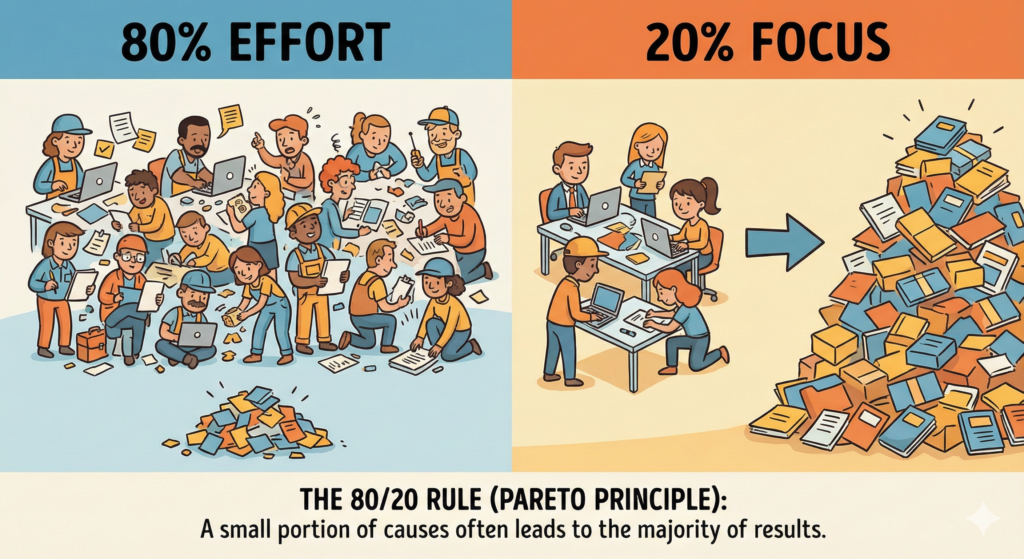
    This is where the 80/20 Rule, also known as the Pareto Principle, becomes a game-changer. It is not just a productivity hack for CEOs or a statistical observation for economists; it is a profound philosophical razor that can slice through the noise of your life and reveal what truly matters. By applying the 80/20 rule to your wishes, you can identify the vital few desires that will bring you the vast majority of your happiness and fulfillment. (For further reading, explore our guide on turn your wishes into concrete goals).

    Understanding the Pareto Principle

    The Pareto Principle was named after Vilfredo Pareto, an Italian economist who, in 1896, noticed a peculiar imbalance in wealth distribution: approximately 80% of the land in Italy was owned by only 20% of the population. Upon further observation, he found this ratio popped up everywhere. In his garden, 20% of the peapods produced 80% of the peas. In business, 80% of sales often come from 20% of clients. In software, 80% of errors are caused by 20% of bugs.

    The core concept is simple: inputs and outputs are rarely equal. A small minority of causes, inputs, or efforts usually lead to a majority of the results, outputs, or rewards. When we apply this to our personal lives and our lists of wishes, the implication is staggering. It suggests that of all the things you think you want, only a small fraction—the “vital few”—are actually responsible for the deep sense of satisfaction and joy you are seeking. The rest—the “trivial many”—are likely distractions, borrowed desires, or things that sound nice but won’t actually move the needle on your happiness. (For further reading, explore our guide on avoiding burnout while setting boundaries). (See also: Encyclopedia Britannica guide to the Pareto Principle).

    The Trap of the Infinite Wish List

    Why do we struggle to prioritize? Often, it is because we operate under the illusion that we have infinite time and energy. We treat our lives like a buffet where we can put everything on our plate. But life is not a buffet; it is a prix fixe menu where you have to make choices. When you load your plate with 50 different items, you end up with a mess of flavors and indigestion. You do not savor anything.

    When you have 20 “top priority” wishes, you have zero priorities. Your energy is scattered. You make an inch of progress in a dozen directions, rather than a mile of progress in the one direction that matters. This dilution of effort leads to burnout, frustration, and the sinking feeling that despite being busy, you are not actually getting anywhere. The 80/20 rule grants you permission to stop trying to be everything to everyone (including yourself) and instead double down on the things that resonate most deeply with your core self.

    Step-by-Step: Applying the 80/20 Rule to Your Wishes

    So, how do we practically apply this abstract economic theory to the emotional and personal realm of our dreams? It requires a deliberate process of auditing, scoring, and eliminating. Here is a guide to decluttering your soul’s inbox.

    1. The Grand Audit

    First, you must capture everything. Take a piece of paper or open a blank document. Write down every single wish, goal, dream, or vague desire currently occupying mental real estate. “Learn to play guitar.” “Buy a vacation home.” “Get a promotion.” “Clean the garage.” “Visit Japan.” Don’t filter yet. If it’s on your mind, it goes on the list.

    You might end up with 20, 50, or even 100 items. Seeing them all in one place can be overwhelming, but it is necessary. You cannot organize clutter until you can see the extent of it.

    2. Calculating the “Happiness ROI”

    Now, look at your list. If the Pareto Principle holds true, roughly 20% of these items will contribute to 80% of your future happiness and fulfillment. If you have 25 items on your list, that means only 5 of them really matter.

    Ask yourself for each item: If I could only achieve this one thing and nothing else on the list, how satisfied would I be with my year/life?

    You will start to notice that some wishes are “foundational.” For example, “Improving my health” might enable you to enjoy everything else. “Repairing my relationship with my sibling” might remove a massive weight from your shoulders, changing your daily mood. In contrast, “Buying a new 4K TV” might provide a spike of dopamine, but its long-term contribution to your fulfillment is negligible.

    3. Identify the “Domino Wishes”

    Tim Ferriss often talks about “domino” actions—things that, if done, make everything else easier or unnecessary. Look for wishes that have a domino effect. Perhaps “Starting a side business” (Wish A) provides the extra income to “Travel more” (Wish B) and “Pay off debt” (Wish C). In this case, focusing on Wish A addresses the others indirectly. The 20% often consists of these high-leverage wishes.

    4. The Pain of Elimination

    Here is the hard part. Once you have identified your top 20%, you must look at the bottom 80%. These are not necessarily “bad” wishes. They are often “good” wishes. They are things you genuinely like. But they are the enemy of the “great.”

    Warren Buffett famously advised his pilot to list his top 25 goals, circle the top 5, and then put the other 20 on an “Avoid At All Costs” list. You don’t just put them on the back burner; you actively avoid them because they are the seductive distractions that will eat up the time you need for your top 5. You have to be willing to mourn the loss of those alternative futures to fully inhabit the one you are choosing.

    Living in the 20% Zone

    When you focus your resources—time, money, emotional bandwidth—on just your top wishes, magic happens. You move faster. You achieve a state of “flow” more easily because you aren’t constantly context-switching between disparate goals. If your top wish is to write a novel, and you cut out the hours spent researching pottery classes (a bottom 80% wish) or browsing real estate (another bottom 80% wish), you suddenly find you have the time to actually write.

    Furthermore, the 20% are usually the wishes that align most closely with your values. The other 80% are often influenced by society, advertising, or peer pressure. By stripping those away, you aren’t just becoming more productive; you are becoming more authentic.

    Overcoming the Fear of Missing Out (FOMO)

    The biggest psychological barrier to the 80/20 rule is FOMO. “But what if I really discover I love pottery?” “What if I regret not learning Italian?”

    The antidote to FOMO is JOMO: the Joy of Missing Out. There is a deep, resonant joy in commitment. When you commit to your top wishes, you go deep rather than wide. The satisfaction of mastery and completion outweighs the shallow thrill of novelty. Remember, prioritizing the 20% doesn’t mean you can never do the other things. It just means you aren’t doing them now. You are sequencing your life instead of trying to run everything in parallel.

    the 80/20 principle at work

    Frequently Asked Questions (FAQ)

    1. Can I have different 80/20 lists for different areas of life?

    Yes. You can apply this rule separately to your career, your relationships, and your hobbies. However, be careful not to create so many sub-categories that you end up with a crowded plate again. Ideally, you should have one master list for your overall time allocation.

    2. What if my top 20% wishes keep changing?

    It is normal for desires to evolve, but if they change weekly, you might be stuck in the dreaming phase rather than the doing phase. Try to stick with your top selection for at least 3 to 6 months to give yourself a chance to see results before re-evaluating.

    3. Is the ratio always exactly 80/20?

    No, it is a heuristic, not a law of physics. It could be 90/10 or 70/30. The point is the inequality: a small number of inputs creates the majority of value. Don’t get hung up on the math; focus on the concept of leverage.

    4. Isn’t this approach selfish?

    Prioritizing your wishes doesn’t mean ignoring your responsibilities to others. In fact, many people find that “Being a better parent” or “Contributing to my community” lands squarely in their top 20%. By clearing out the trivial clutter, you often have more energy to be present for the people who matter most.

    The Courage to Choose

    Using the 80/20 rule to prioritize your wishes is ultimately an act of courage. It requires the bravery to say “no” to good things so that you can say “yes” to the best things. It forces you to confront the finitude of your time and make peace with it.

    Take a look at your list today. Find those golden few, the wishes that make your heart race, the ones that align with your deepest purpose, the ones that, if fulfilled, would make you feel that your life has been well-spent. Circle them. Cherish them. And then, gently but firmly, let the rest go. Your future self, unburdened and fulfilled, will thank you for it.

  • Turning Wish into Goal: 5-Step Practical Guide to Success

    Turning Wish into Goal: 5-Step Practical Guide to Success

    The 5-Step Guide to Turning Your Wish into a Goal (And Actually Achieving It)

    Step # Transformation Stage Key Output Frequency
    Step 1 Crystallize Vision Specific SMART Goal statement Initial setup
    Step 2 Define “Why” Emotional Anchor statement Initial setup
    Step 3 Reverse Engineer Path 1% Daily micro-actions Daily
    Step 4 Set Deadline & Urgency Target milestone date Weekly check-in
    Step 5 Execute, Measure & Pivot Weekly Review log Weekly

    Have you ever caught yourself staring out the window, thinking, “I wish I could do that”?

    We all have. We wish for financial freedom, we wish for a fitter body, we wish to write a book, or we wish to travel the world. But here is the harsh truth about wishes: a wish is passive. A wish waits for luck to strike. A wish assumes that the universe will align perfectly to drop success into your lap.

    A goal, however, is active. A goal is a wish with a spine. It has structure, a timeline, and a plan of attack.

    The gap between “I wish” and “I did” is often smaller than we think, but crossing it requires a shift in mindset and a rigorous strategy. If you are tired of daydreaming and ready to start executing, you are in the right place.

    In this comprehensive guide, we will break down the exact 5 step process for turning your wish into a goal. This isn’t just about writing a list; it is about fundamentally changing how you approach your desires to ensure success.

    Step 1: Crystallize the Vision (Move from Vague to Specific)

    The number one reason wishes die is ambiguity. When you say, “I wish I had more money,” your brain doesn’t know what to do with that information. Vague money wishes are too abstract. Without a clear target, you cannot aim.

    To turn a wish into a goal, you must apply the SMART criteria immediately. Your goal must be Specific, Measurable, Achievable, Relevant, and Time-bound.

    The Specificity Test

    Ask yourself: If I achieved this goal, what would it look like in a photograph?

    • The Wish: “I want to get in shape.”
    • The Goal: “I will reduce my body fat percentage to 15% and run a 5k in under 25 minutes.”
    • The Wish: “I want to be rich.”
    • The Goal: “I will increase my passive income to $2,000 per month through dividend stocks and affiliate marketing.”

    When you define the specific outcome, you activate the Reticular Activating System (RAS) in your brain. This is the filter that helps you focus on what matters. Suddenly, you start seeing opportunities that align with your specific goal because you have finally told your brain exactly what you are looking for.

    Action Item: Write down your wish. Now, rewrite it so that a stranger could read it and know exactly what success looks like without asking you any questions.

    Step 2: Define Your “Why” (The Emotional Anchor)

    Logic makes us think, but emotion makes us act.

    You can have the most perfectly structured plan on paper, but if you don’t have a burning emotional connection to the result, you will quit the moment things get difficult. And things will get difficult.

    This step is about digging deep to find your Emotional Anchor. This is the underlying reason that will keep you moving forward when you are tired, stressed, or unmotivated.

    The “5 Whys” Technique

    To find your anchor, ask “Why?” five times.

    • Goal: I want to start an online business.
      1. Why? To make extra money.
      2. Why? So I can quit my 9 to 5 job.
      3. Why? Because I hate having a boss and a rigid schedule.
      4. Why? Because I want to be present for my children as they grow up.
      5. Why? Because my father was always working when I was a kid, and I don’t want to repeat that cycle.

    Now we have the truth. You aren’t just building a business for money; you are building it to break a generational cycle and be a better parent. That is a goal worth fighting for.

    Action Item: Journal your “5 Whys.” Once you find the core emotional reason, write it on a sticky note and place it where you will see it every single morning.

    Step 3: Reverse Engineer the Path (The Action Plan)

    A goal without a plan is just a wish. This is the stage where most people get overwhelmed. A massive goal like “Write a Novel” feels insurmountable. The secret is Reverse Engineering.

    Start from the finish line and work backward to today.

    Breaking It Down

    Imagine your goal is a mountain. You cannot jump to the summit. You have to establish base camps.

    1. The Macro Goal: Launch a website in 6 months.
    2. Monthly Milestone: Month 1: Choose niche and domain. Month 2: Set up hosting and design. Month 3: Write 10 articles…
    3. Weekly Target: This week, I need to research 5 potential niches.
    4. Daily Habit: Today, I will spend 30 minutes reading about SEO. Setting small daily habits is what ultimately leads to major accomplishments.

    By the time you get to the daily habit, the task is no longer scary. It is manageable. You aren’t “building a business” today; you are simply “registering a domain name.”

    The 1% Rule

    Do not underestimate the power of compound effort. Improving by just 1% every day results in a 37x improvement over the course of a year. Focus on the micro-steps.

    Action Item: Create a roadmap. Break your goal into 3 major milestones. Then, break the first milestone into weekly tasks. Finally, decide what is the one thing you can do in the next 24 hours to start.

    Step 4: Set a Deadline and Create Urgency

    Parkinson’s Law states: “Work expands to fill the time available for its completion.”

    If you give yourself a year to clean your garage, it will take a year. If you give yourself 3 hours because guests are coming over, it will take 3 hours.

    Wishes are open-ended. Goals have deadlines. Without a deadline, procrastination is inevitable. You need to create a sense of urgency, even if it is artificial.

    Types of Deadlines

    1. Hard Deadlines: These are external. Example: Signing up for a marathon. The race date won’t change just because you didn’t train.
    2. Soft Deadlines: These are internal. Example: “I want to finish this chapter by Friday.”

    To make soft deadlines effective, you need accountability stakes.

    • The Financial Stake: Give a friend $50. If you don’t hit your weekly goal, they keep the money. If you do, you get it back.
    • The Social Stake: Post your goal publicly on social media. The fear of public failure is a powerful motivator.

    Action Item: Open your calendar. Mark the “Done Date.” Now, mark the halfway checkpoint. Treat these dates as unmovable appointments with your future self.

    Step 5: Execute, Measure, and Pivot (The Feedback Loop)

    The plan you made in Step 3 is a hypothesis. You won’t know if it works until you test it.

    Many people treat their plan as a rigid document. If they miss one day, they feel they have “failed” and abandon the goal entirely. This is the wrong approach. You must adopt the mindset of a scientist.

    The Weekly Review

    You must schedule a meeting with yourself once a week (Sunday evenings act as a great time for this). During this review, ask three questions:

    1. What did I accomplish this week? (Celebrate the wins).
    2. Where did I fall short? (Identify the obstacles).
    3. What do I need to change for next week? (Pivot the strategy).

    If you aimed to go to the gym 5 times but only went twice because you were too tired after work, don’t beat yourself up. Pivot. Change the plan to go in the morning before work.

    The path to a goal is never a straight line. It is a zigzag. The most successful people are not the ones who never fail; they are the ones who can adjust their course the fastest.

    Action Item: Set a recurring alarm on your phone for a “Weekly Goal Review.” Never skip this meeting.

    Bonus: Overcoming the “Valley of Despair”

    Every goal follows an emotional cycle.

    1. Uninformed Optimism: The beginning. You are excited! “This will be easy!”
    2. Informed Pessimism: You realize it’s hard work. “This isn’t fun anymore.”
    3. The Valley of Despair: The point where most people quit. You see the effort but no results yet.
    4. Informed Optimism: You start seeing small wins. You get your rhythm back.
    5. Success/Completion: The goal is a habit or achieved.

    When you are in the Valley of Despair, remember that it is a natural part of the process. It is not a sign that you should stop; it is a sign that you are about to breakthrough.

    Conclusion

    Turning a wish into a goal is not magic; it is mechanics. It requires taking the ethereal dream floating in your head and forging it into reality through specificity, emotional connection, planning, urgency, and consistent review.

    Remember, the time will pass anyway. Five years from now, you will either say, “I wish I had started,” or “I am so glad I did.”

    You have the 5 step framework. The wish is in your head. The pen is in your hand. The rest is up to you.

    Ready to start? Leave a comment below with the ONE wish you are turning into a goal today. Let’s hold each other accountable.

    FAQ: Frequently Asked Questions

    1. What is the main difference between a wish and a goal? A wish is a desire without a plan (e.g., “I wish I were wealthy”). A goal is a specific objective with a deadline and an actionable plan (e.g., “I will save $10,000 for a down payment by December 31st”). A goal implies responsibility and action.

    2. How many goals should I set at once? It is recommended to focus on one to three major goals at a time. Trying to overhaul your finance, health, career, and relationships simultaneously often leads to burnout. Focus on one “Keystone Goal” that, if achieved, might help the other areas of your life naturally improve.

    3. What should I do if I miss my deadline? Don’t panic and don’t quit. A missed deadline is just data. Analyze why you missed it. Was the deadline unrealistic? Did unexpected life events occur? simply reset the deadline based on your current reality and keep moving. Progress is better than perfection.

    4. How do I stay motivated when I don’t see results immediately? Focus on lead measures (actions you take, like writing 500 words/day) rather than lag measures (results, like selling 1,000 books). If you consistently hit your lead measures, the results will eventually catch up. Also, revisit your “Why” (Step 2) to reconnect with your purpose.

    5. Is it okay to change my goal halfway through? Absolutely. Flexibility is key. If you realize halfway through that the goal no longer aligns with your values or life direction, it is smarter to pivot or abandon it than to continue just for the sake of finishing. However, ensure you aren’t quitting just because it’s difficult.