Using the 80/20 Rule to Prioritize Your Most Important Wishes
In a world overflowing with possibilities, it is all too easy to find ourselves drowning in a sea of desires. We want to travel the world, learn three new languages, start a business, get in the best shape of our lives, spend more time with family, read 50 books a year, and somehow also find time to relax. Our wish lists grow endlessly, filled with everything from life-changing ambitions to fleeting fancies. But here is the harsh truth: trying to do everything often means accomplishing nothing.
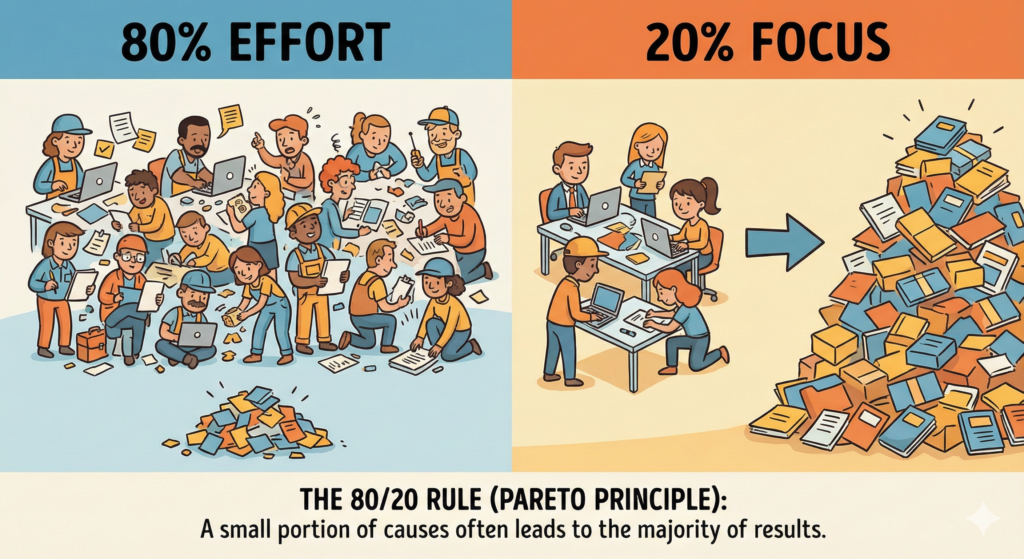
This is where the 80/20 Rule, also known as the Pareto Principle, becomes a game-changer. It is not just a productivity hack for CEOs or a statistical observation for economists; it is a profound philosophical razor that can slice through the noise of your life and reveal what truly matters. By applying the 80/20 rule to your wishes, you can identify the vital few desires that will bring you the vast majority of your happiness and fulfillment.
Understanding the Pareto Principle
The Pareto Principle was named after Vilfredo Pareto, an Italian economist who, in 1896, noticed a peculiar imbalance in wealth distribution: approximately 80% of the land in Italy was owned by only 20% of the population. Upon further observation, he found this ratio popped up everywhere. In his garden, 20% of the peapods produced 80% of the peas. In business, 80% of sales often come from 20% of clients. In software, 80% of errors are caused by 20% of bugs.
The core concept is simple: inputs and outputs are rarely equal. A small minority of causes, inputs, or efforts usually lead to a majority of the results, outputs, or rewards. When we apply this to our personal lives and our lists of wishes, the implication is staggering. It suggests that of all the things you think you want, only a small fraction—the “vital few”—are actually responsible for the deep sense of satisfaction and joy you are seeking. The rest—the “trivial many”—are likely distractions, borrowed desires, or things that sound nice but won’t actually move the needle on your happiness.
The Trap of the Infinite Wish List
Why do we struggle to prioritize? Often, it is because we operate under the illusion that we have infinite time and energy. We treat our lives like a buffet where we can put everything on our plate. But life is not a buffet; it is a prix fixe menu where you have to make choices. When you load your plate with 50 different items, you end up with a mess of flavors and indigestion. You do not savor anything.
When you have 20 “top priority” wishes, you have zero priorities. Your energy is scattered. You make an inch of progress in a dozen directions, rather than a mile of progress in the one direction that matters. This dilution of effort leads to burnout, frustration, and the sinking feeling that despite being busy, you are not actually getting anywhere. The 80/20 rule grants you permission to stop trying to be everything to everyone (including yourself) and instead double down on the things that resonate most deeply with your core self.
Step-by-Step: Applying the 80/20 Rule to Your Wishes
So, how do we practically apply this abstract economic theory to the emotional and personal realm of our dreams? It requires a deliberate process of auditing, scoring, and eliminating. Here is a guide to decluttering your soul’s inbox.
1. The Grand Audit
First, you must capture everything. Take a piece of paper or open a blank document. Write down every single wish, goal, dream, or vague desire currently occupying mental real estate. “Learn to play guitar.” “Buy a vacation home.” “Get a promotion.” “Clean the garage.” “Visit Japan.” Don’t filter yet. If it’s on your mind, it goes on the list.
You might end up with 20, 50, or even 100 items. Seeing them all in one place can be overwhelming, but it is necessary. You cannot organize clutter until you can see the extent of it.
2. Calculating the “Happiness ROI”
Now, look at your list. If the Pareto Principle holds true, roughly 20% of these items will contribute to 80% of your future happiness and fulfillment. If you have 25 items on your list, that means only 5 of them really matter.
Ask yourself for each item: If I could only achieve this one thing and nothing else on the list, how satisfied would I be with my year/life?
You will start to notice that some wishes are “foundational.” For example, “Improving my health” might enable you to enjoy everything else. “Repairing my relationship with my sibling” might remove a massive weight from your shoulders, changing your daily mood. In contrast, “Buying a new 4K TV” might provide a spike of dopamine, but its long-term contribution to your fulfillment is negligible.
3. Identify the “Domino Wishes”
Tim Ferriss often talks about “domino” actions—things that, if done, make everything else easier or unnecessary. Look for wishes that have a domino effect. Perhaps “Starting a side business” (Wish A) provides the extra income to “Travel more” (Wish B) and “Pay off debt” (Wish C). In this case, focusing on Wish A addresses the others indirectly. The 20% often consists of these high-leverage wishes.
4. The Pain of Elimination
Here is the hard part. Once you have identified your top 20%, you must look at the bottom 80%. These are not necessarily “bad” wishes. They are often “good” wishes. They are things you genuinely like. But they are the enemy of the “great.”
Warren Buffett famously advised his pilot to list his top 25 goals, circle the top 5, and then put the other 20 on an “Avoid At All Costs” list. You don’t just put them on the back burner; you actively avoid them because they are the seductive distractions that will eat up the time you need for your top 5. You have to be willing to mourn the loss of those alternative futures to fully inhabit the one you are choosing.
Living in the 20% Zone
When you focus your resources—time, money, emotional bandwidth—on just your top wishes, magic happens. You move faster. You achieve a state of “flow” more easily because you aren’t constantly context-switching between disparate goals. If your top wish is to write a novel, and you cut out the hours spent researching pottery classes (a bottom 80% wish) or browsing real estate (another bottom 80% wish), you suddenly find you have the time to actually write.
Furthermore, the 20% are usually the wishes that align most closely with your values. The other 80% are often influenced by society, advertising, or peer pressure. By stripping those away, you aren’t just becoming more productive; you are becoming more authentic.
Overcoming the Fear of Missing Out (FOMO)
The biggest psychological barrier to the 80/20 rule is FOMO. “But what if I really discover I love pottery?” “What if I regret not learning Italian?”
The antidote to FOMO is JOMO: the Joy of Missing Out. There is a deep, resonant joy in commitment. When you commit to your top wishes, you go deep rather than wide. The satisfaction of mastery and completion outweighs the shallow thrill of novelty. Remember, prioritizing the 20% doesn’t mean you can never do the other things. It just means you aren’t doing them now. You are sequencing your life instead of trying to run everything in parallel.
Frequently Asked Questions (FAQ)
1. Can I have different 80/20 lists for different areas of life?
Yes. You can apply this rule separately to your career, your relationships, and your hobbies. However, be careful not to create so many sub-categories that you end up with a crowded plate again. Ideally, you should have one master list for your overall time allocation.
2. What if my top 20% wishes keep changing?
It is normal for desires to evolve, but if they change weekly, you might be stuck in the dreaming phase rather than the doing phase. Try to stick with your top selection for at least 3 to 6 months to give yourself a chance to see results before re-evaluating.
3. Is the ratio always exactly 80/20?
No, it is a heuristic, not a law of physics. It could be 90/10 or 70/30. The point is the inequality: a small number of inputs creates the majority of value. Don’t get hung up on the math; focus on the concept of leverage.
4. Isn’t this approach selfish?
Prioritizing your wishes doesn’t mean ignoring your responsibilities to others. In fact, many people find that “Being a better parent” or “Contributing to my community” lands squarely in their top 20%. By clearing out the trivial clutter, you often have more energy to be present for the people who matter most.
The Courage to Choose
Using the 80/20 rule to prioritize your wishes is ultimately an act of courage. It requires the bravery to say “no” to good things so that you can say “yes” to the best things. It forces you to confront the finitude of your time and make peace with it.
Take a look at your list today. Find those golden few, the wishes that make your heart race, the ones that align with your deepest purpose, the ones that, if fulfilled, would make you feel that your life has been well-spent. Circle them. Cherish them. And then, gently but firmly, let the rest go. Your future self, unburdened and fulfilled, will thank you for it.

I transform ideas into solutions. I write things, help people and like to learn.